I Made Jev Do My SEO Audit: One URL, Three Reports, 93/100
By Agrici Daniel | September 22, 2026
Jev SEO turns one homepage into a full SEO audit: a PDF, an Excel tracker and a Markdown report, judged by Jev with every answer's confidence shown.

Jev SEO is a free, open-source skill that turns one homepage URL into a full SEO audit: a designed PDF, an Excel action tracker and a Markdown report. It is built on Jev, TypeSafe's new System One model, and every judgment it makes comes with how sure it is. I ran it on my own site, it scored 93/100, and the Jev part of the run cost about 2 cents.
I built Jev SEO, so this is a first-party write-up, not an independent review. The code is public under the MIT license on GitHub.
Watch the walkthrough
The video shows one full run, the three reports, how I checked the numbers by hand, and how to install it. It runs 11 minutes 32 seconds.
The short version
- One input: a homepage URL. It crawls up to 60 pages, respects robots.txt and runs 52 rules tied to Google Search Central.
- Jev answers only what code cannot: page type, intent, helpfulness, trust, keyword relevance. Each answer keeps its probability.
- Sure answers become verdicts. The rest are flagged "to verify" in every report.
- Three outputs from one audit.json: a PDF for the client, an XLSX to track the work, a Markdown file for GitHub, Obsidian or any agent.
- Standard mode costs about 1 cent of Jev per site. Full mode adds DataForSEO for about 0.30 USD.
What Jev is, and why SEO fits it
Jev is TypeSafe AI's System One model. It does not write text. You give it a state and typed questions, and it returns a Choice, a Noul (a yes or no probability) or a Score, each with the probability behind it. Think of it as a decision layer: routing, classifying, checking.
This week every Jev video I found explained what the model is. I wanted to see it do a job. SEO is a good one, because an audit is mostly decisions: is this page a product page or a guide, does it answer the query, is this keyword about my site or someone else's brand. A chat model writes a confident paragraph about those. Jev returns a number I can threshold.
That matters because SEO audits have a slop problem. I wrote about the cheaper side of this in free SEO audit tools that work, and about replacing a paid stack in Claude Code and the SEO stack. Jev SEO is the next step: the same checks, with the judgment calls made measurable.
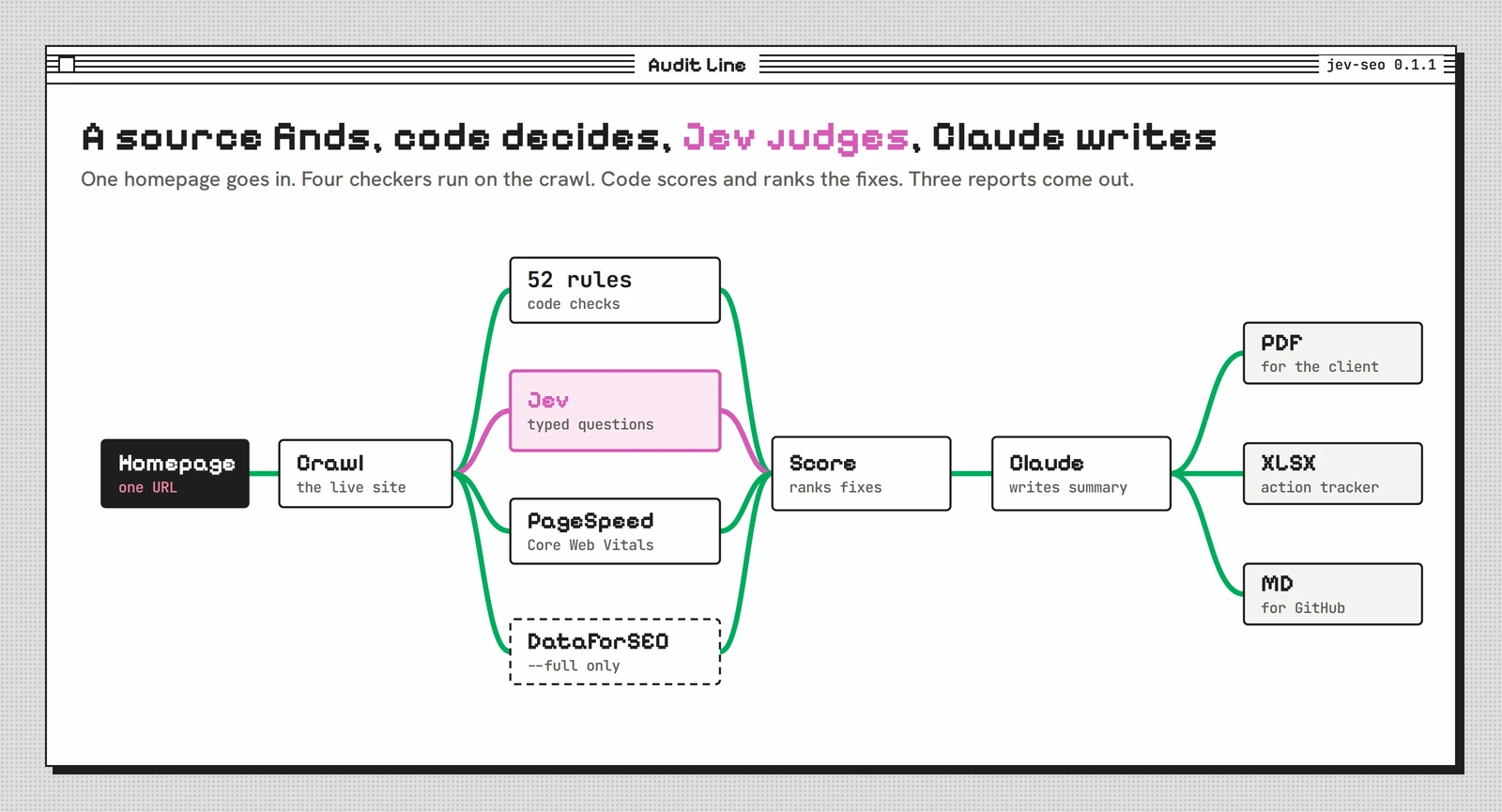
How one audit runs: a source finds, code decides, Jev judges, Claude writes
Each stage does only what it is good at. Anything a count, a status code or a string match can decide is decided by code. Nothing is invented to fill a gap: missing data is shown as missing.
| Stage | Owns | Never does |
|---|---|---|
| Code | Crawling, status codes, counts, duplicates, schema parsing, formulas, ranking | Guess at meaning |
| Jev | Page type, search intent, importance, helpfulness, specificity, trust, citability, title and meta fit, competing page pairs | Predict rankings or traffic, invent data |
| PageSpeed | Chrome UX Report field data and Lighthouse lab scores | Stand in for every page or device |
| Claude | The summary and plan, citing action IDs | Add findings the evidence does not show |
The video walks through eight moments from one real run. Each is a real finding, not a demo script:
| Moment | What happened | Result |
|---|---|---|
| A full run | 60 pages crawled, 52 rules, Jev on 60 pages, 98 keywords and 40 page pairs, PageSpeed on 3 pages | 93/100, 11 ranked actions, three reports |
| A rule finds a fix | www.claude-seo.md answered 307, a temporary redirect | JEV-006: make the redirect permanent (P3, effort 1) |
| Jev is sure | Does the homepage say what the site offers? 1.00, confidence 1.00 | A verdict |
| Jev is unsure | Do four posts open with the point? 0.42 on average | JEV-008 ships as a signal marked to verify |
| Keyword worth winning | sxo: 720 searches a month, position 18, difficulty 0, relevance 0.77 | JEV-001: close to page one |
| Off-topic keyword | seo michael: position 15, relevance 0.09 | Dropped, never reaches the plan |
| No TypeSafe key | Jev is not asked | Reports still written, labelled partial audit |
| Claude slips up | A draft cites JEV-099, which does not exist | Refused before render |
Every answer comes with how sure it is
This is the part I care about most. Most AI audits sound sure about everything. Jev returns a probability, and code reads it. For yes or no questions, 0.80 and above is a sure yes, 0.20 and below is a sure no, and everything between is a signal for a human to check.
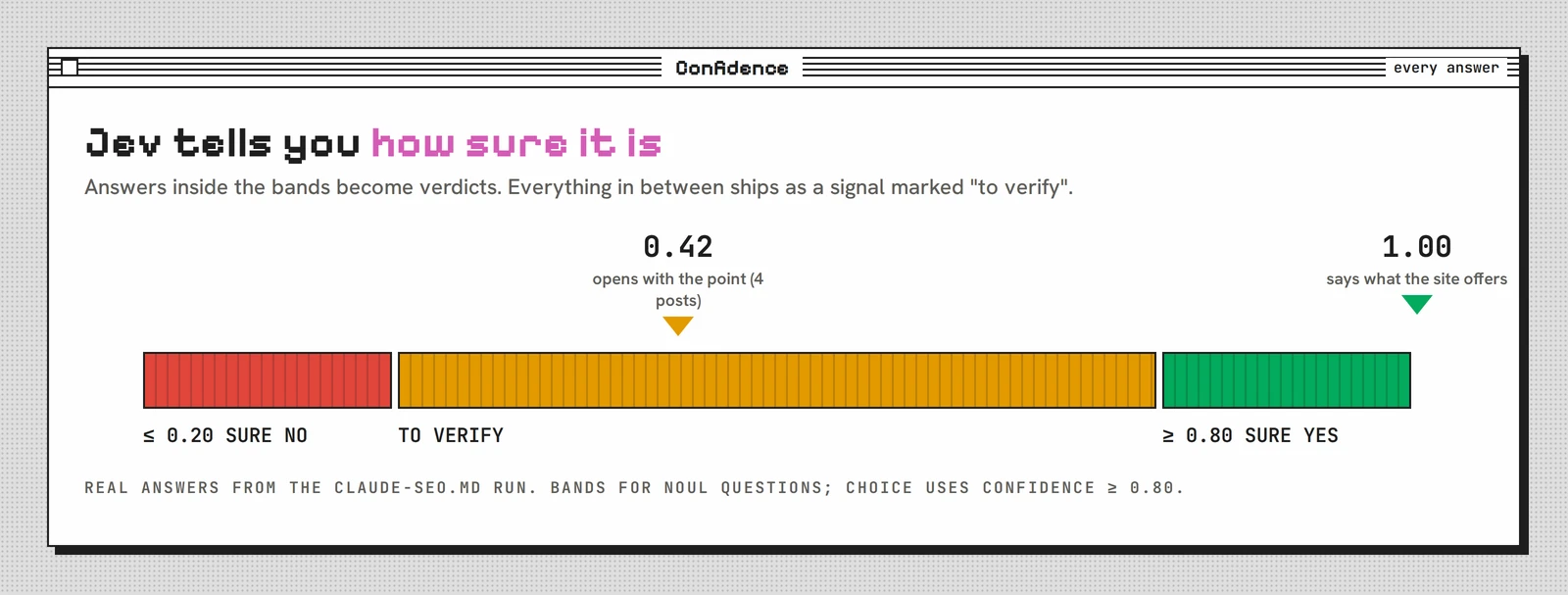
Choice questions use Jev's own confidence, also at 0.80. Score questions use the probability on one side of the midpoint. That last rule came from an A/B test, covered below.
The three reports
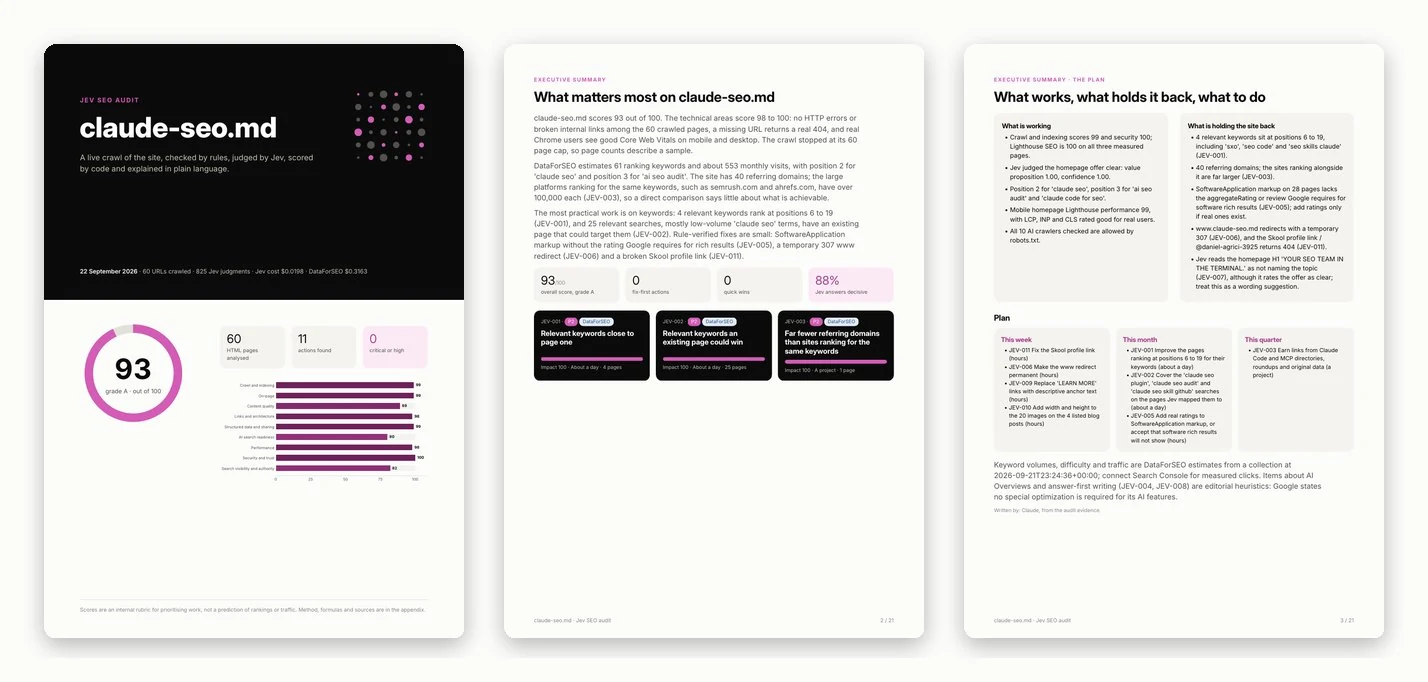
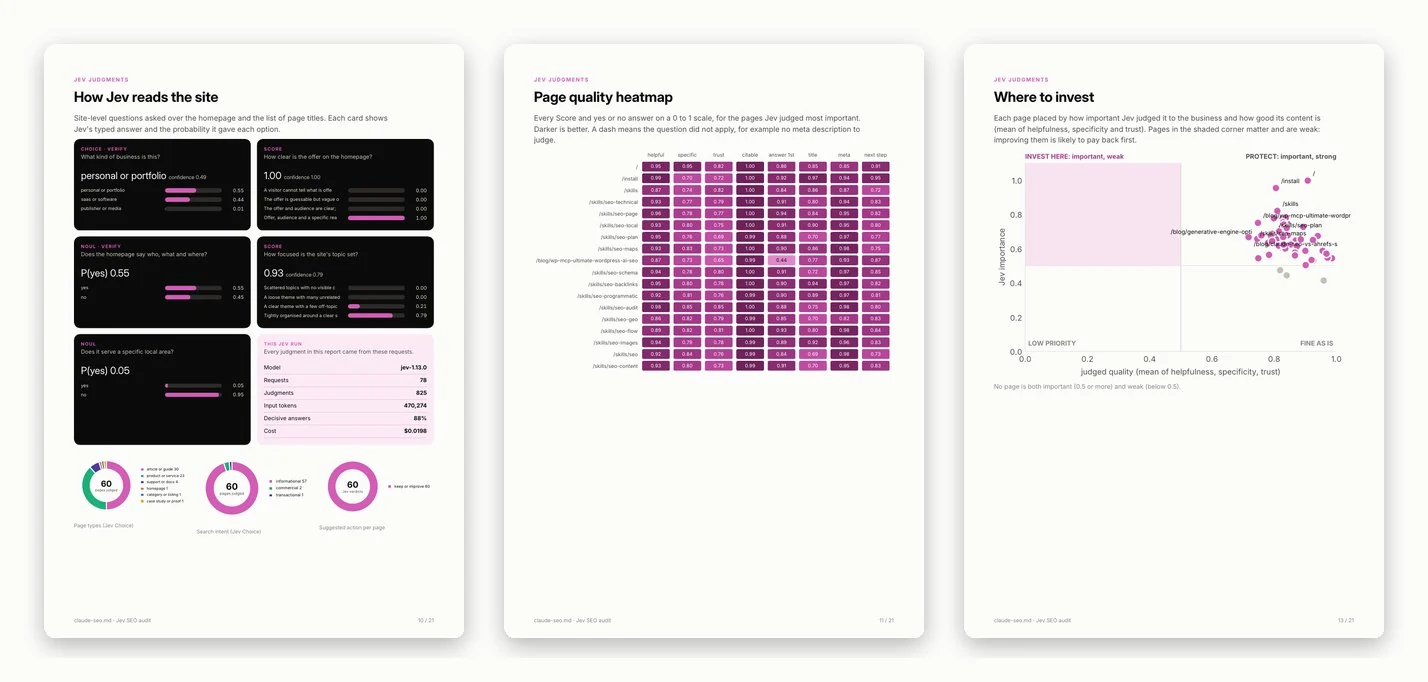
All three are built from the same audit.json, so they never disagree. The PDF is for the client: cover, summary, the three actions that matter, a plan, and pages on how Jev reads the site.
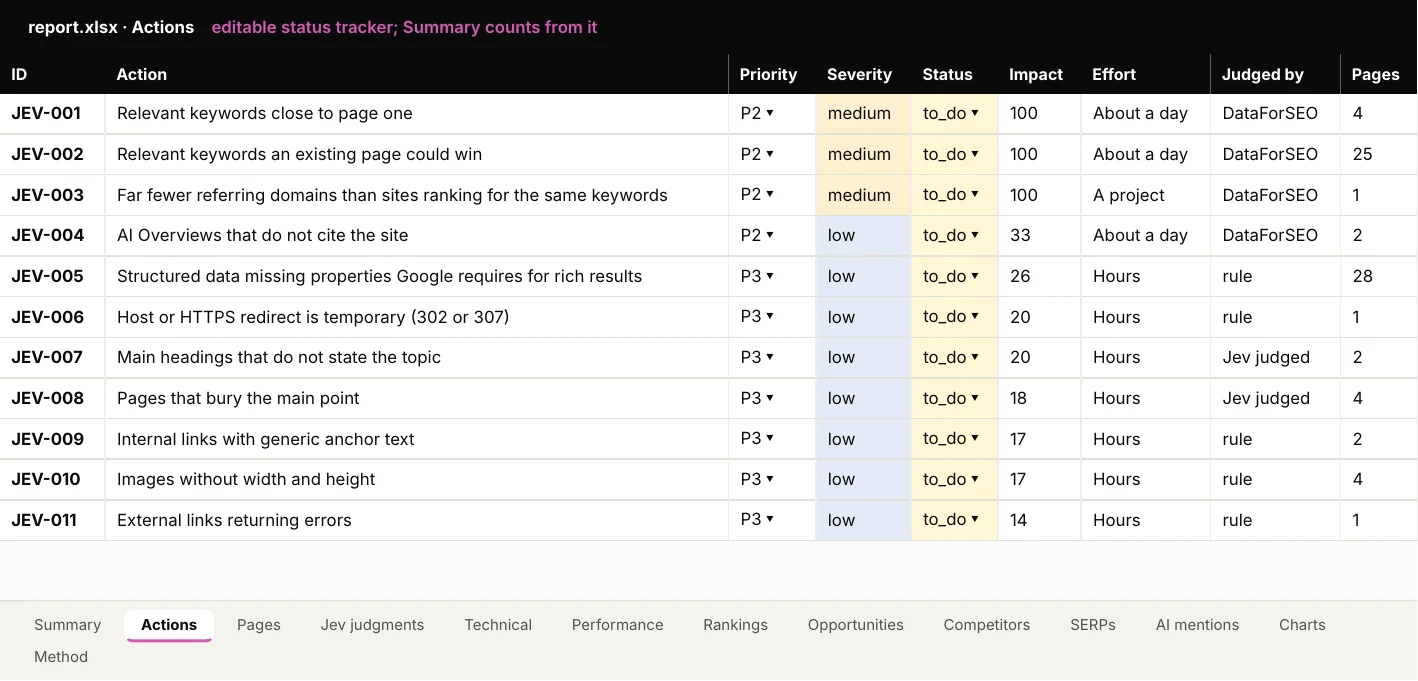
The Excel workbook is the working copy. The Actions sheet has status dropdowns, and the Summary counts update from it. The raw Jev answers are there too, with probabilities, so you can audit the auditor.
The Markdown report renders on GitHub and in Obsidian, with charts. It is also the cleanest format to hand to another agent.
One real run: claude-seo.md in numbers
I ran full mode on claude-seo.md on 22 September 2026. Every file from that run, including the PDF, workbook and Markdown, is in the repository's examples folder, so you can check each number.
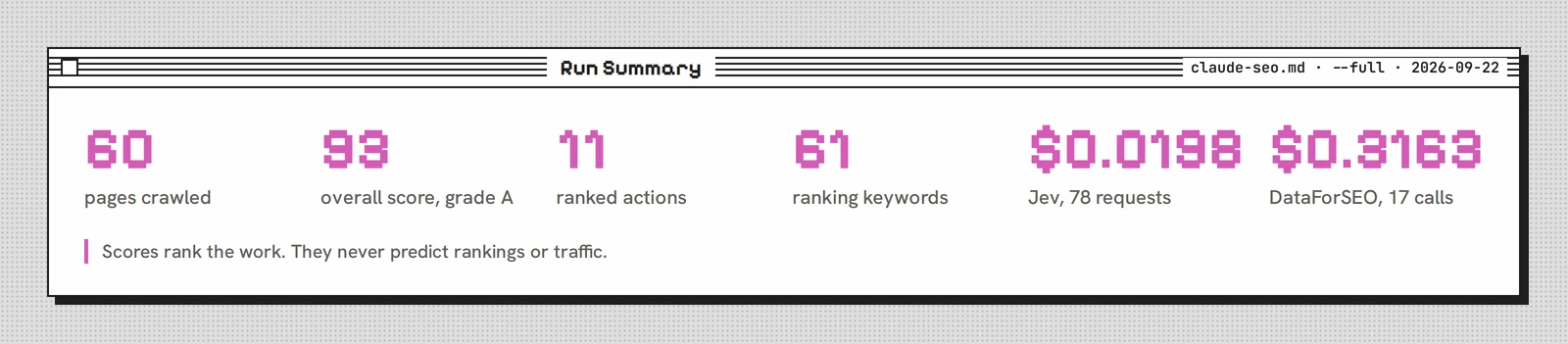
I checked the report against PageSpeed Insights and Search Console by hand. The scores and field values matched. The whole run took about five minutes.
How far to trust it
I did not assume the questions were good. I A/B tested every Jev question on the same 30 pages and 40 keywords, and kept the wording that made Jev sure more often and right when sure.
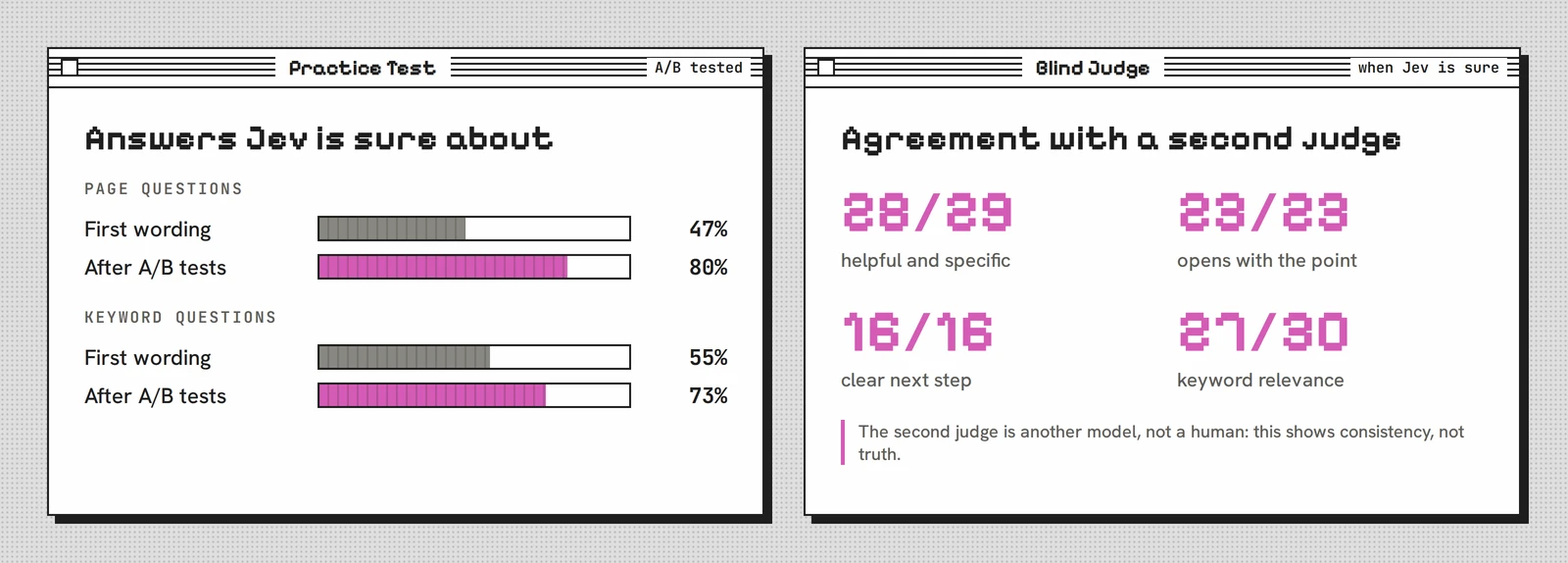
The same 59 pages judged twice moved by 0.03 or less on average. The honest caveat: the second judge is another model, not a human, so this shows Jev is consistent and reasonable, not that it is right. The full numbers, including the weak spots, are in the evaluation file.
What it costs
| Part | Where it runs | Cost |
|---|---|---|
| Crawl, rules, scoring, charts, PDF, XLSX, MD | Your machine | Free |
| Core Web Vitals and Lighthouse | Google PageSpeed Insights API | Free |
| Page, site and keyword judgments | TypeSafe Jev API | About 1 cent per site (0.0198 USD for the full run below) |
| Rankings, keywords, competitors, backlinks (full mode) | DataForSEO API | About 0.30 USD per site, hard cap 1.00 USD |
You do not need Search Console to run it. I used it only to double-check my own report. A PageSpeed API key is optional, but without it PageSpeed is often rate limited.
What it does not do
- It does not predict rankings, traffic or revenue. Scores rank the work.
- It does not replace Search Console or track positions over time.
- Large sites are sampled at 60 pages, and the report says so.
- DataForSEO volumes, difficulty and traffic are estimates.
- Jev's thresholds are not yet tuned against human labels. That is the next step.
Run it on your site
It runs as a Claude Code skill or from the command line. The fastest path is to paste the repository link into your agent and ask it to install the skill. By hand:
git clone https://github.com/AgriciDaniel/jev-seo.git
cd jev-seo && pip install -r requirements.txt
cp .env.example .env        # add TYPESAFE_API_KEY
ln -s "$PWD" ~/.claude/skills/jev-seo
/jev-seo https://your-site.com
bin/jevseo audit https://your-site.com --full   # optional: add DataForSEO
If you want more skills like this, my guide to Claude Code skills covers the rest of the set.
Frequently asked questions
What is Jev by TypeSafe?
Jev is TypeSafe AI's System One model. It does not write text. It answers typed questions, a choice, a yes or no, or a score, and returns the probability behind each answer. That makes it a decision layer for routing, classifying and checking.
Can AI do an SEO audit?
Yes, when the AI is not the one inventing numbers. In Jev SEO, a source finds the data, code decides everything countable against 52 rules, Jev judges meaning, and Claude writes the summary. Any number in the summary that is not in the audit gets flagged.
Can Claude Code help with SEO?
Yes. Claude Code runs Jev SEO as a skill: type /jev-seo and a homepage URL. It crawls up to 60 pages, runs the checks, asks Jev, measures Core Web Vitals and renders a PDF, an Excel tracker and a Markdown report.
How much does an SEO audit with Jev SEO cost?
The skill is free and MIT licensed. Jev costs about 1 cent per site in standard mode. PageSpeed Insights is free. Full mode adds DataForSEO rankings, keywords and backlinks for about 0.30 USD per site.
Do I need Google Search Console to run it?
No. Jev SEO reads the live site, PageSpeed Insights and, in full mode, DataForSEO. I used Search Console only to double-check my own report by hand.
Can I trust Jev's answers?
Trust the ones it is sure about, and check the rest. Answers inside the confidence bands become verdicts. Everything else is flagged to verify in all three reports. Jev's thresholds are not yet tuned against human labels.
Let the model say when it is unsure
The interesting part of Jev is not speed or price. It is that it tells you how sure it is, so code can decide what becomes a verdict and what goes to a human. For SEO, that is the difference between an audit you act on and one you have to re-check line by line. Run it, check the score, and tell me where it is wrong.
Jev SEO is an independent open-source project. It is not affiliated with, sponsored by, or endorsed by TypeSafe AI, Anthropic, Google or DataForSEO.