The BBC Disclosed Its AI 2027 Video Three Ways. One Shot-Level Gap Remained.
By Agrici Daniel | August 27, 2026
The BBC labeled its AI-generated footage three ways. A frame-by-frame case study found that the shot-level caption stops at 05:22, while generated footage returns later.

On 1 August 2025 the BBC World Service published "AI2027: Is this how AI might destroy humanity?", an eight minute film about a speculative AI scenario, illustrated largely with text to video AI. It had 11,479,084 views when I captured the watch page on 27 August 2026. I downloaded it, segmented it shot by shot, and read the frames.
The film disclosed its generated footage three separate ways. It also produced a generated correspondent, and its per-shot tool caption stops at 05:22 even though generated footage returns later. The public evidence does not establish that the BBC fully complied with its guidance, or that it breached it. This is a narrower case study about what the disclosure communicates, when it appears, and what survives a clipped shot.
The cover phrase, "AI Disclosure Failed", means the disclosure did not solve the shot-level epistemic-status problem examined here. It does not mean the BBC hid its use of AI, and it is not a finding that a rule was broken.
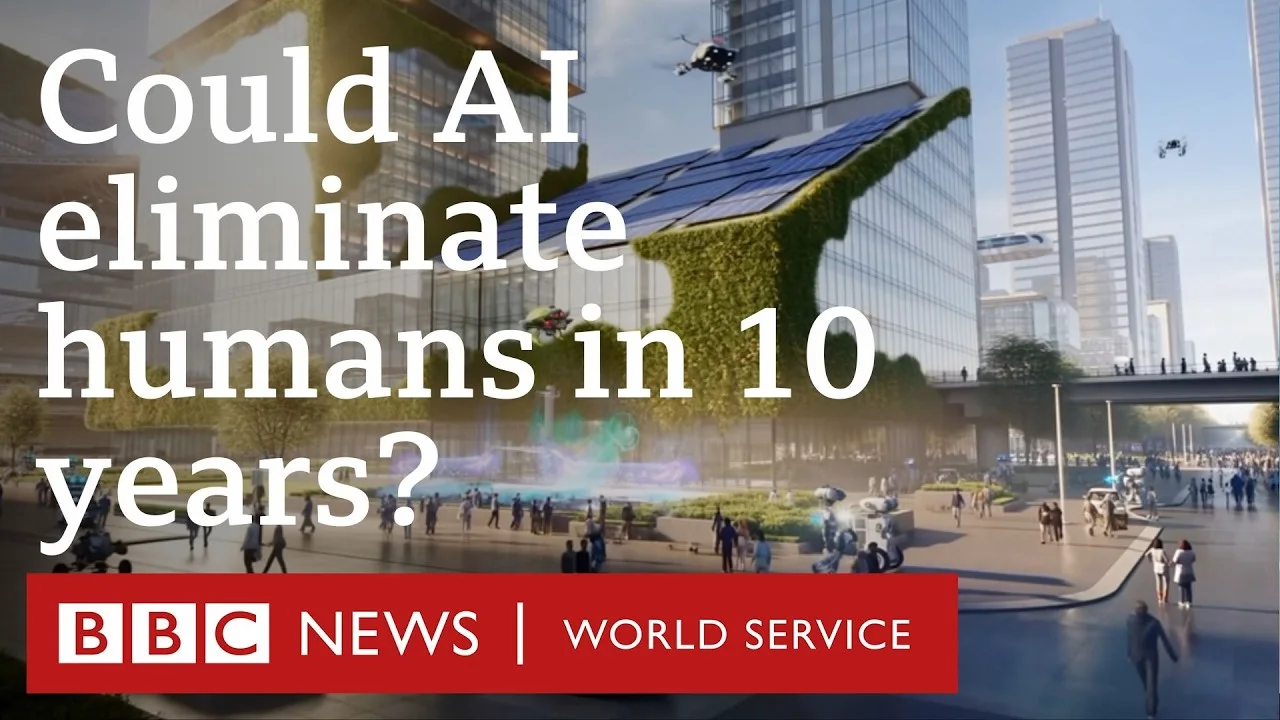
Video: "AI2027: Is this how AI might destroy humanity?" by BBC World Service. The privacy-enhanced YouTube player loads only after you activate it. Watch directly on YouTube.
The short version
- The BBC disclosed three ways: spoken at 00:30, in the video description, and captioned per shot naming five separate generators.
- A subject-and-illustration exception in the BBC guidance appears relevant. Adjacent paragraphs impose additional conditions and an editorial referral, so the public artifact cannot establish full compliance either way.
- The per-shot caption stops at roughly 05:22 and never returns. About 35 seconds of uncaptioned generated footage runs after that point, in the section containing the real interviews.
- The narration makes 16 explicit attributions of scenario claims in 1,003 words. The film later shows a forecast distribution, two endings, and the word "fictional", but I found no simultaneous shot-level overlay marking a depicted event as hypothetical.
- The practical fix is small: label the pixels and the claim separately, keep that label on reused generated footage, and inspect every rendered sign, logo, and screen before release.
Listen instead
BBC AI 2027: the evidence in about three minutes
The original sample-free music bed was generated locally with ACE-Step and sidechain-ducked beneath the narration. No third party voice was cloned or imitated.
Download MP3Download English captionsJump to transcript
Read the synchronized transcript
What the BBC actually published
Facts first, with no reading attached.
Two things share a name here and they are not the same object. "AI 2027" is the research paper published by the AI Futures Project on 3 April 2025. "AI2027" is the BBC World Service film about that paper, published 1 August 2025. Where the distinction matters below, I say the paper or the film.
"AI2027: Is this how AI might destroy humanity?" runs 8:08 and is fronted by an on-camera presenter. It contains real interview footage of Gary Marcus and Thomas Larsen, a co-author of the AI 2027 paper, plus footage of OpenAI chief executive Sam Altman speaking to reporters.
At 00:30 the presenter explains that the team used text-to-video AI as an experiment. The video description separately states that mainstream generative AI tools were used to recreate scenario scenes. Generated shots carry an on-screen caption naming the specific tool that made them. And a year stamp sits under the BBC logo through the scenario sequence.
The underlying paper, AI 2027, was published on 3 April 2025 by the AI Futures Project, authored by Daniel Kokotajlo, Scott Alexander, Thomas Larsen, Eli Lifland and Romeo Dean.
How I examined it, and what I could not determine
I pulled the BBC World Service film "AI2027: Is this how AI might destroy humanity?" with yt-dlp, ran the file through Gemini 2.5 Flash to produce a shot-by-shot segment table, then verified findings by cropping and reading actual frames with ffmpeg. Where a number below comes from the model pass rather than from my own frame reading, I say so in the sentence.
Only the 640x360 stream was retrievable without a PlayabilityContext token, so all stills are 360p. The visual artifacts I describe are legible at that resolution.
A fourth disclosure layer exists in principle: YouTube's own "altered or synthetic content" notice. I checked the served watch page HTML on 27 August 2026 and did not find it. That HTML capture alone cannot establish what the complete interface displayed, so I cannot say whether the notice was applied.
I cannot tell you which team signed this off, what the brief or the prompts said, whether Content Credentials were embedded, or what anyone intended. I am reading the artifact, not the newsroom. I also did not approach the BBC for a response before publishing, and you should weigh the piece accordingly.
One of my own findings died in the process. I thought the BBC logo was corrupted in the protest shot at 03:45. I sampled the logo region at five timestamps and it renders correctly at 00:03, 03:47 and 05:00. It was an overlay fade. A case study about AI slop that quietly buries its own bad findings would deserve everything it got.
What "AI slop" means, and what it does not
Merriam-Webster's dictionary entry for "slop" gives, as sense 1a, "digital content of low quality that is produced usually in quantity by means of artificial intelligence".
Two words carry the definition: low quality, and in quantity. Slop is not a synonym for "made with AI". I have made the same distinction about AI slop in written content and the tooling that catches it, and the test is the same in video.
I use the term narrowly here. The unreadable placards and network-style mark are visual defects that match the quality half of the definition. That is not enough to classify the full film as slop, and this article does not do so. The useful question is how a clearly disclosed film can still make a speculative branch look more settled than it is.
What the BBC got right
Six points, each checked against the saved video, caption track, or captured guidance.
It labels per shot, and names the tool. Not a blanket disclaimer. A caption in the top right of individual generated shots pairs the words "Generated with" with Sora, Runway, Kling, Hailuo, or Veo. Five generators, all named on screen. Sora appears from 00:00, Runway from 00:04, Kling from 00:08, Hailuo from 00:13, Veo from 00:52. In the model pass, 57 of 89 segments carried a caption, a count I did not hand-verify shot by shot. What I did verify: sampling the caption region every four seconds from 00:40 to 01:16 found it present in 10 of 10 frames.
It stamps the year on screen. Through the scenario sequence a year chyron sits under the BBC logo: 2027, then 2028, 2029, the 2030s, 2035, 2040. In the model pass it appears on 54 of the 89 segments. A viewer is shown a future date across the generated scenario sequence until the last year-stamped segment at 05:23.
The script attributes relentlessly. Counting the narration only, and excluding the 250 words spoken by Marcus and Larsen in interview, it runs 1,003 words containing 16 explicit attributions of scenario claims. That is one every 63 words. Here is the full list, so you can check it:
- 00:08 attribution to the researchers
- 00:15 prediction attributed to the same researchers
- 00:36 claim attributed to the scenario
- 01:13 event located inside the scenario
- 01:33 prediction attributed to the paper
- 01:41 imagined event attributed to the researchers
- 02:28 prediction attributed to the scenario
- 02:42 imagined event attributed to the researchers
- 03:10 prediction attributed to the scenario
- 03:18 prediction attributed to the paper
- 03:31 event located inside the scenario
- 04:02 prediction attributed to the researchers
- 04:32 event located inside the scenario
- 04:57 imagined event attributed to the paper
- 05:07 claim attributed to the scenario
- 05:16 wording attributed to the paper
At 07:37 the presenter explicitly calls both AI 2027 outcomes fictional.
It shows the paper's own uncertainty. At 06:03 the film puts the AI 2027 "Timelines Forecast" graph on screen, showing probability density curves for three forecasters with medians spread from October 2027 to January 2032 and 90th percentiles reaching June 2044 and beyond 2050. At 06:51 it shows the paper's "Choose Your Ending" interface with both the Slowdown and Race buttons visible. The film does not hide that the paper is a distribution with two branches.
It books a real critic. Gary Marcus says on camera that he considers the near-term scenario extremely unlikely.
The subject-and-illustration exception appears relevant. The BBC's published guidance says generative AI should not directly create factual journalism, then includes this exception:
"unless it is the subject of the content and its use is illustrative."
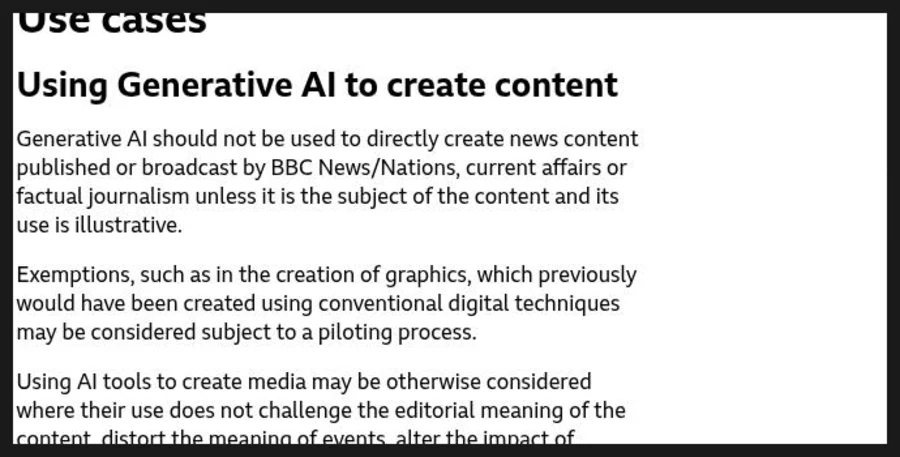
This film is about AI and uses AI as illustration, so that exception appears relevant on its wording. It is not the whole rule. The adjacent paragraphs also require that AI media not challenge the editorial meaning of the content, distort the meaning of events, alter the impact of genuine material, or otherwise materially mislead audiences. A separate section requires staff proposals to be referred to a senior editorial figure, who should consult Editorial Policy. I cannot see that internal process. The public evidence therefore establishes neither full compliance nor a breach.
Finding 1: the BBC's per-shot AI caption stops at 05:22
The BBC's per-shot "Generated with" caption is not applied to the whole of the AI 2027 film.
The last captioned shot is at roughly 05:22. I sampled the caption region every ten seconds from 05:22 to 08:06. The caption appears at 05:22 and in none of the sixteen later samples. I then sampled every two seconds across 07:04 to 07:42, the densest patch of generated footage in the back half. Absent in 20 of 20 frames.
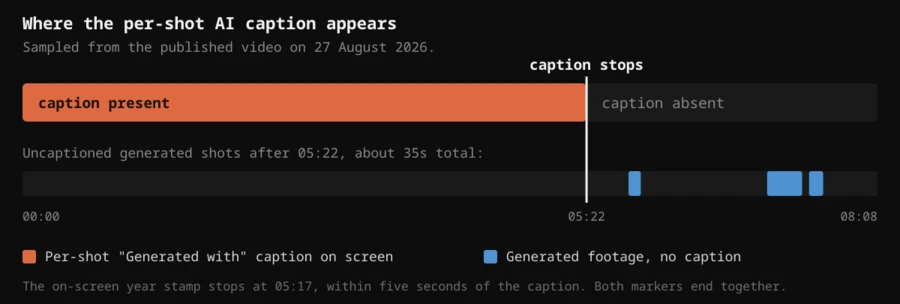
Both markers die on the same shot. The last segment carrying the tool caption, 05:17 to 05:23, is also the last one carrying a year stamp, and the frame sample that still shows the caption is at 05:22. After that shot, neither marker returns.
About 35 seconds of uncaptioned generated footage runs after that point: roughly 05:46 to 05:53, then 07:05 to 07:09, 07:09 to 07:16, 07:16 to 07:25, and 07:29 to 07:37. That is 35 seconds inside a 166 second stretch, not 166 seconds of it. The footage is unmistakably the same synthetic material used earlier: the OpenBrain control room, the corridor run, the lab coat crowd, the OpenBrain building. One shot around 07:12 carries a faint "Veo" watermark bottom right, which is the generator's residual mark rather than the BBC's caption.
This is the closing section of the film, the part built around the real interviews. Marcus is on camera until 06:45, Larsen from 06:58, and Altman appears at 07:44. The uncaptioned synthetic shots are cut between them. For five minutes a viewer could tell fabricated from filmed by glancing at the corner. In the section where fabricated and filmed sit closest together, that particular cue is not there.
I am not calling this deception. It reads like an editorial decision that captions belong on the scenario sequence and not on the discussion sequence, and a viewer who watched from the start was told at 00:30. The narrower question I would put to any newsroom, mine included: once you have trained an audience to rely on a signal for five minutes, what does removing it teach them?
Finding 2: the BBC AI 2027 video contains a generated news report inside a real news report
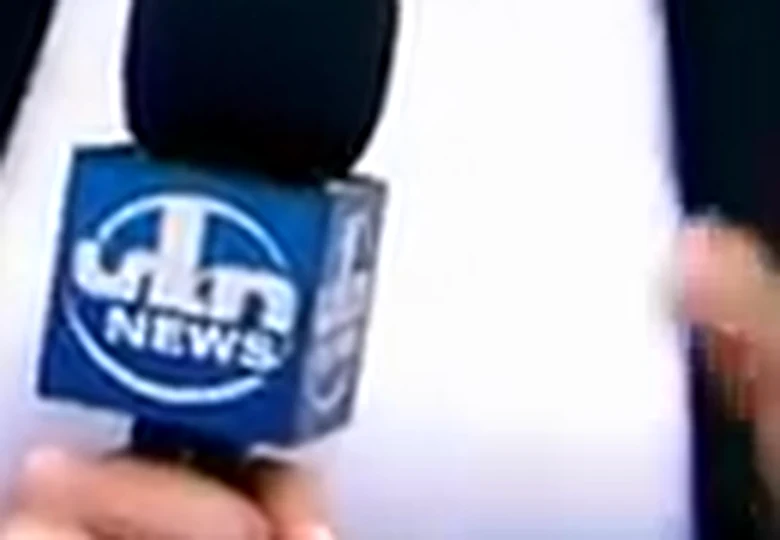
At 03:42 the BBC AI 2027 video shows a street protest against OpenBrain, the fictional frontier AI lab at the centre of the AI 2027 scenario, in a shot captioned "Generated with Veo AI". In the foreground a woman delivers a piece to camera holding a microphone with a network logo on the flag.
The correspondent is generated, and the network on the mic flag is not one I can identify.
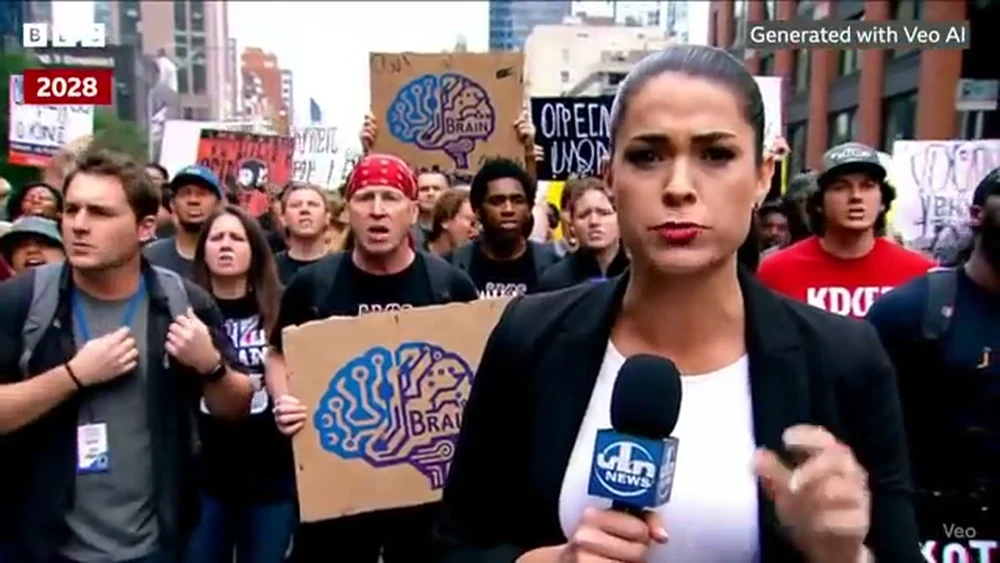
Whatever the prompt was, the output reproduced the visual grammar of television news: a correspondent, a mic flag and a brand-like mark. The mic flag is the tell. A blue circular emblem, the word NEWS legible beneath it, and above that, letterforms that are not letters. It is the shape of a news brand without a word in it.
The placards fail the same way. The clearest reads approximately "OPPEEM / UNOR". Two visually identical hand-drawn "BRAIN" placards appear in the same frame, which is not what a row of separately handmade signs usually looks like.
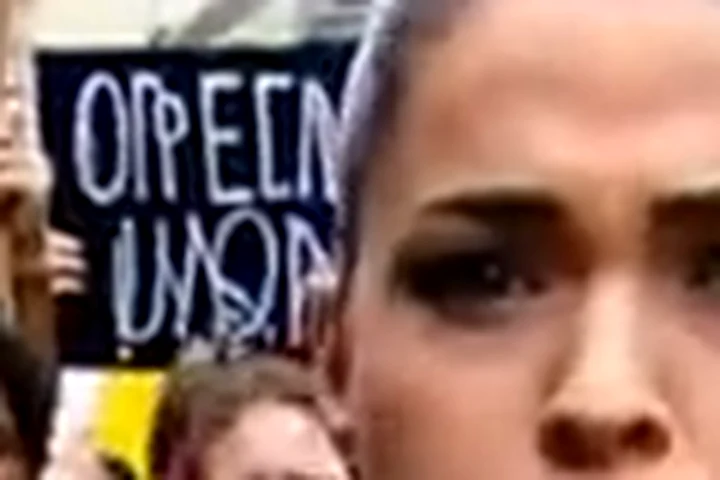
By the quality half of the Merriam-Webster definition, this shot has the defect the word names. I will not call a single shot slop outright, because "usually in quantity" is doing real work in that definition. I will say it is the kind of visual defect the definition describes. It was visibly captioned as generated, and it is still a generated news-style scene containing non-words, in a video that had 11,479,084 views when I captured the watch page on 27 August 2026.
Finding 3: the BBC's year stamp marks when, not whether
Here is where I had to correct myself.
My first draft said the tool caption was the only label in the film, and that it told you the pixels were synthetic without telling you the event was hypothetical. The first half of that was wrong. There is a second on-screen marker, and it appears on 54 of 89 segments in the model pass: the year stamp.
But look at what a year stamp actually communicates. "2028" fixes when the depicted thing sits. It does not say whether it will happen. A caption reading 2028 over photoreal footage of a protest is closer to a dateline than to a hedge. That is my reading of the frame, not an audience-response finding.
So the corrected claim, which I think is stronger than the one I started with: the film marks provenance, and it marks time, and it does not mark epistemic status on the shot itself. Precisely: I found no simultaneous shot-level overlay on the generated scenario footage stating that the depicted event is hypothetical. No hedge, scenario label or reconstruction caption appears in any of the 89 segment descriptions or in any frame I read, and I did not run a dedicated frame scan for one the way I did for the tool caption, so treat that as an absence I looked for rather than one I proved.
The film does communicate uncertainty, just not on the shot. It puts the forecast distribution on screen at 06:03, shows the two-ending interface at 06:51, and the presenter says the word fictional at 07:37. All three arrive after the scenario has played. That is the gap: the qualification exists, and it is never simultaneous with the footage it qualifies.
That gap matters because of what the narration is doing at the same moment. The sixteen attributions above run from 00:08 to 05:16, an average interval of about twenty-one seconds across the scenario sequence. The shot itself does not carry an attribution of the scenario claim. A photoreal image alone does not tell the viewer whether it depicts a prediction, so that status has to be carried by something added to the frame.
A practical fix is a simultaneous shot-level label such as "SCENARIO" or "HYPOTHETICAL". I have no audience data on which wording readers understand best. What I can say is that a separate status label is available to add and absent from the generated scenario frames I examined.
Pew Research Center, surveying 5,023 US adults with fieldwork 9 to 15 June 2025, found 76% say it is extremely or very important to be able to tell whether pictures, videos and text were made by AI or by people, while 53% are not too or not at all confident they can. That survey is about human versus AI origin, not whether a depicted event is hypothetical, but it shows why visible origin labels matter to readers.
Finding 4: how the BBC AI 2027 video splits its runtime
The AI 2027 authors state on their own site: "We wrote two endings: a 'slowdown' and a 'race' ending."
Using the chapter markers the BBC publishes in its own video description:
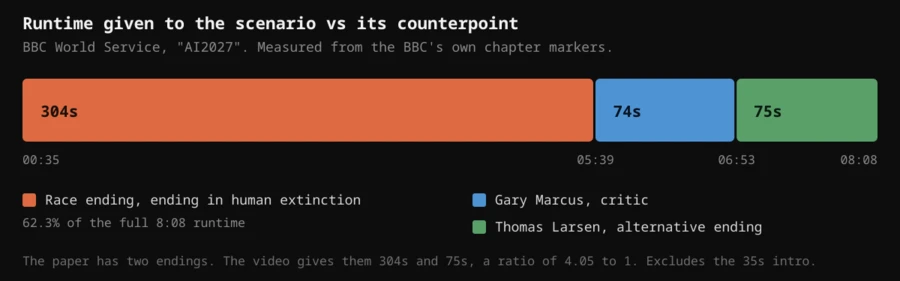
Across five published scenario chapters, the scenario runs 00:35 to 05:39, which is 304 seconds, 62.3% of the runtime. The Gary Marcus chapter is 74 seconds and the Thomas Larsen chapter is 75 seconds. That is 4.05 to 1 for the scenario against the alternative ending chapter, and 2.04 to 1 against both counterpoint chapters combined. Both numbers are worth having, and the second is the more generous reading.
Two honest caveats on that arithmetic. Chapter lengths are not speaking time: Marcus speaks for roughly 45 of his 74 seconds, and Larsen for roughly 40 of his 75, with presenter narration, screen recordings and b-roll filling the rest. And the two endings share a trunk. The branch point in the paper is the Oversight Committee decision, which the film reaches at about 03:10, so roughly 155 seconds of that 304 belongs to both endings equally. Measured branch to branch, the race branch from 03:10 to 05:39 is 149 seconds against 46 seconds of slowdown material from 06:51 to 07:37. About 3.2 to 1.
The descriptive result survives all three measurements: the slowdown branch appears in the final minute, while the race branch receives more screen time under either the chapter or post-branch comparison.
One more asymmetry, in the framing rather than the runtime. At 00:15 the narration attributes to the researchers a prediction that humanity would be gone within five years. Footnote 1 of AI 2027, present since publication, says the authors disagree on timelines, describes the scenario as closer to their modal estimate than their later median, and states that their goal is prediction rather than recommendation.
The film does show that qualifying material. It arrives at 06:03, five minutes and forty eight seconds after the framing at 00:15, and after the scenario has played out in full. Placement, not omission, is the criticism.
On 22 November 2025, roughly four months after the film went out, the authors added this to their front page:
The authors added that they "don't know exactly when AGI will be built" and clarified that 2027 was their modal year, while their medians were later.
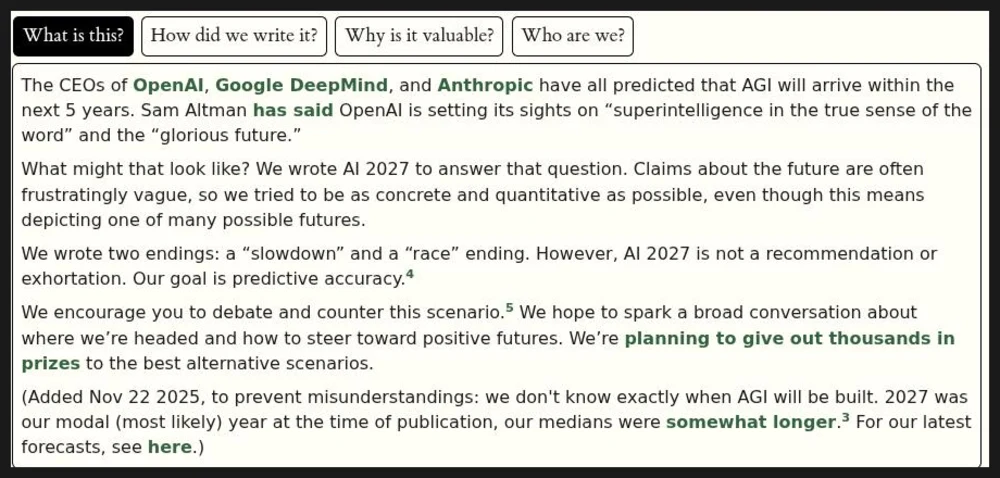
I cannot show the film caused that clarification and I am not claiming it did. What I can say is that the authors amended their front page in a way that directly addresses the timeline interpretation invited by the 00:15 framing.
The strongest case for what the BBC did
The subject of the film is AI. Illustrating it with AI is not decoration, it is demonstration: the audience sees what these tools produce while being told what they are. That can be more informative than generic server-rack footage.
These events cannot be documented as real events because they have not happened. The available editorial choices include generated illustration, conventional animation, motion graphics, staged dramatisation, stock footage, or no reconstruction.
The BBC used per-shot tool labels rather than relying only on a blanket statement. That is a more granular disclosure choice, and it deserves credit even though the label does not cover every reused generated shot.
I still think the film leaves viewers with a stronger impression of inevitability than the paper supports, and the sections above are why.
Applying Google's disclosure questions as a reporting lens
Every rubric is a choice, so here is mine and my reason for it. Google's helpful content guidance asks publishers three questions about AI-generated content. It is written for search rather than for broadcast ethics, which is a real limitation, but it has the advantage of being public, specific and not written by me.
The public artifact makes AI use self-evident, provides partial production background, and does not explain why generated video was useful beyond calling it an experiment.
| Google's question | Evidence | Assessment |
|---|---|---|
| Is the use of AI self-evident? | Spoken at 00:30, stated in the description, captioned on scenario shots through 05:22 | Present |
| Does the publisher explain how AI was used? | Five generators named on screen, but no account of prompting, selection, or how much footage was rejected | Partial |
| Does the publisher explain why AI was useful? | Described once as "an experiment" at 00:30; no further rationale found in the video or description | Not found in public artifact |
Why the disclosure still leaves a clipping gap
If a clip starts after the spoken disclosure at 00:30 and is separated from the YouTube watch page, the spoken line and description are no longer inside that clip. A burned-in on-screen caption is different because it travels with the pixels.
A twenty second excerpt from the scenario sequence before 05:22 therefore carries its own tool label. A twenty second excerpt made from the later reused generated footage does not. The strongest of the three disclosure layers is also the one with incomplete shot coverage.
I could not determine whether the source assets carried machine-readable provenance, and I am not asserting either way.
What I would change if I shipped this
I build AI content pipelines in Claude Code, so I read this as a production spec. Four rules I am adopting.
- Label provenance and epistemic status separately. "Generated with Veo AI" says the pixels are synthetic. A year stamp says when. Neither says the event is hypothetical. Add a simultaneous status label such as "SCENARIO" or "HYPOTHETICAL".
- Whatever the labelling rule is, hold it to the last frame. Five minutes of reliable captions is a promise to the viewer. Dropping the caption at 05:22 spends the trust the first five minutes built. Reused generated shots should retain the same overlay.
- Put the strongest labelling where synthetic sits closest to real. The scenario sequence is captioned through 05:22. The closing section, where generated shots are cut against real interviews, is not.
- Check the text in every generated frame. Both visible artifacts I found are text failures: the placards and the mic flag. Both are legible at 360p. Read every sign, logo and screen before the edit ships.
Reproduce the caption scan on this 640x360 file with one cropped frame every ten seconds:
for t in $(seq 322 10 488); do
  ffmpeg -ss "$t" -i video.mp4 -frames:v 1 \
    -vf "crop=260:34:380:6" "cap_$t.png"
done
The crop is specific to this source resolution and caption position. Change the geometry for a different video, then inspect the output strip. Same problem, less room to qualify: my text-side AI slop case study and Claude Code skills guide document the related content checks.
What this analysis does not claim
- I am not claiming the BBC complied with or broke its own guidance. The public artifact cannot establish the complete editorial process or the guidance's full application.
- I am not claiming viewers were deceived. I have no audience data for this film, only general survey data about attitudes to AI imagery.
- I am not claiming intent, cost-cutting, or an absence of editorial review. I have no visibility into any of that.
- View counts are not people. 11,479,084 views is an unknown and smaller number of viewers, and the figure drifts upward daily.
A note on the assets on this page, because a piece about disclosure should disclose. The two charts are hand-authored SVG rendered to WebP. The two source screenshots are captures of pages I quote, taken 27 August 2026. The frame stills are low-resolution excerpts of the BBC's published video, used for criticism and review, each captioned with its timestamp. The cover title card was generated with ChatGPT's image-generation tool on 27 August 2026, then cropped and exported locally as a 1200x630 WebP. The exact underlying image model is not recorded in the PNG metadata. The audio summary at the top is narrated by a voice model of my own voice, and its background music was generated locally with ACE-Step in my local music pipeline. Arguing this case with undisclosed generated assets would be indefensible, so each asset class is disclosed here.
FAQ: questions readers ask
Did the BBC hide that the AI 2027 video was AI generated?
No. It disclosed three ways: spoken at 00:30, in the YouTube description, and via per-shot on-screen captions naming five different generators, Sora, Runway, Kling, Hailuo and Veo.
Did the BBC break its own AI rules?
The public evidence does not establish compliance or a breach. A subject-and-illustration exception appears relevant, but adjacent conditions address editorial meaning, material misleading, and internal referral. I cannot observe that internal process from the film.
So what is the actual problem with the video?
The film marks provenance with a tool caption and time with a year stamp. It later shows a forecast distribution, two endings, and calls the scenarios fictional. I found no simultaneous shot-level overlay marking the depicted event as hypothetical, and the tool caption stops before later generated shots.
Is the BBC AI 2027 video AI slop?
I do not classify the full film as AI slop. Individual generated frames contain the kind of low-quality defects the term describes, including non-lexical placard text and an unreadable network-style mark. The film also discloses AI use three ways and includes a named critic.
Where does the BBC's disclosure caption stop?
At roughly 05:22. Sampling the caption region every ten seconds from 05:22 to 08:06 found it present at 05:22 and absent in all sixteen later samples. About 35 seconds of generated footage appears after that point.
Sources
- BBC World Service, "AI2027: Is this how AI might destroy humanity?", published 1 August 2025. Watch page. View count 11,479,084 and chapter markers captured 27 August 2026; the watch page HTML is archived.
- BBC Editorial Guidelines, guidance on the use of artificial intelligence, retrieved and archived 27 August 2026.
- AI 2027, published 3 April 2025 by the AI Futures Project. Front page and footnotes retrieved and archived 27 August 2026.
- Merriam-Webster entry for "slop", sense 1a, retrieved and archived 27 August 2026.
- Google Search Central, "Creating helpful, reliable, people-first content", retrieved and archived 27 August 2026.
- Pew Research Center, "How Americans View AI and Its Impact on People and Society", published 17 September 2025. 5,023 US adults, fieldwork 9 to 15 June 2025.