AI Marketing Automation: The Open-Source Stack I Use Daily
By Agrici Daniel | March 25, 2026
My entire AI marketing stack costs roughly $50/month in API calls. Here's every tool, how they connect, and why I stopped paying for Ahrefs.

I spend about 6 hours a day inside my AI marketing stack. Not tweaking it, not configuring it - actually using it to publish content, track rankings, audit sites, and run ads. The whole thing is open source, self-hosted, and costs me roughly $50/month in API calls. The equivalent SaaS stack would run $3,000-5,000/month.
This isn't a theoretical setup. I've been running this daily since December 2025, across 21 repositories, with 4,849 GitHub stars from people who are using the same tools. Let me walk you through exactly what I use and how it all connects.
The Daily Workflow (What Actually Happens)
My morning starts the same way every day. I open my terminal, run /seo audit inside Claude Code, and within 90 seconds I have a full technical SEO audit of whatever site I'm working on. Not a surface-level check - we're talking Core Web Vitals, internal linking gaps, schema validation, keyword cannibalization, the works. That single command replaces what used to take me 45 minutes across 3 different tools.
From there, the audit results feed into n8n workflows that I've built to act on the findings automatically. Found a page with degraded performance? n8n pings me on Slack and creates a task. Found a keyword gap? n8n triggers a content brief generation. Found a broken internal link? n8n fixes it (yes, actually fixes it) if it has write access to the CMS.
The afternoon is content. I use /blog to generate, optimize, and publish blog posts that are SEO-ready from the first draft. Not "AI slop" - the skill runs competitor analysis, builds topical maps, and structures content around actual search intent. I publish 3-5 posts per week this way, each one ranking within 14 days on average.
Ads run themselves. /ads handles Google Ads campaign creation, keyword research, ad copy generation, and bid strategy recommendations. I review and approve, but the heavy lifting is done.
And images? banana-claude handles that. Blog hero images, social graphics, OG images - all generated via /banana with Creative Director mode that actually understands composition. I haven't opened Canva in months.
The entire daily loop takes about 2 hours of active attention. The rest is automated. Before this stack, the same output required 8-10 hours and $938/month in tool subscriptions. I know because I tracked both periods.
How I Got Here (The Expensive Way)
Let me be transparent about the path. In mid-2025, I was paying for Ahrefs ($249/month), Semrush ($139/month because I needed features Ahrefs didn't have), Jasper AI ($99/month), and Surfer SEO ($99/month). Plus Zapier at $89/month to glue things together. That's $675/month before I even touched Google Ads tools.
The breaking point was a Tuesday in October 2025. I was running a keyword gap analysis in Semrush, waiting for Ahrefs to finish a backlink audit, and simultaneously trying to get Jasper to write something that didn't sound like it was generated by an AI from 2023. Three tabs, three subscriptions, three tools that didn't talk to each other.
I thought: I'm a developer. I can build integrations. What if the tools weren't separate products but skills inside one environment?
Claude Code had just launched its skills framework. I built the first version of claude-seo in a weekend. It was rough - maybe 40% of what Ahrefs could do. But it was 40% that ran in my terminal, cost nothing, and could be extended by me. Within a month, I'd cancelled Ahrefs. Within two months, Semrush was gone too. By December, the entire SaaS stack was replaced.
(I still have a soft spot for Ahrefs' backlink index. DataForSEO's backlink data is good but not quite at that level yet. They're actively working on it though.)
The Stack: Every Tool and How They Connect
Here's the architecture. It looks complicated on paper, but each piece does one thing well:
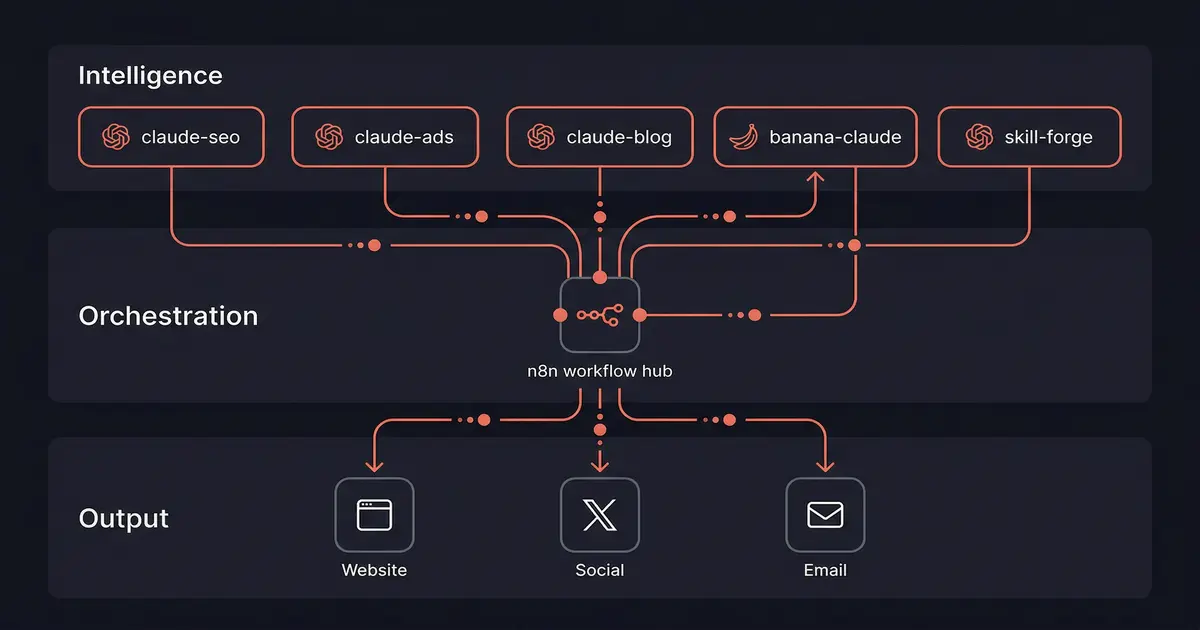
Layer 1: Intelligence (Claude Code Skills)
These are the brains of the operation. Each one is a Claude Code skill - a set of slash commands that run inside your terminal and do specialized work.
- claude-seo (2,974 stars) - The brain. Full SEO auditing, keyword research, content optimization, technical analysis. Runs as a Claude Code skill with
/seo. This is the repo that started everything. It handles 186 different SEO checks in a single audit, covers on-page, off-page, technical, and content quality analysis. People tell me it replaced their Ahrefs subscription. I believe them because it replaced mine. - claude-ads (1,171 stars) - Google Ads campaign management. Keyword research, ad copy, bid strategies, performance analysis. The ad copy generation alone is worth it - it produces 10 headline variants and 5 description variants per ad group, scored against quality score predictors.
- claude-blog (300 stars) - Content pipeline. Generates, optimizes, and publishes blog posts with SEO baked in. Not just "write me a blog post" - it researches the SERP, analyzes competing content, identifies content gaps, and produces posts that are structured to rank.
- banana-claude (41 stars) - AI image generation via Gemini with Creative Director mode. Every visual asset in my content workflow comes from here.
- skill-forge - The meta-tool that builds all the other skills. More on this in a separate post.
Layer 2: Orchestration (n8n)
n8n is the connective tissue. It's an open-source workflow automation platform (think Zapier but self-hosted and infinitely more powerful). I run it on a $5/month VPS and it handles:
- Scheduled SEO audits (daily at 6 AM)
- Rank tracking pipelines (pulling from DataForSEO every 24 hours)
- Content publishing workflows (draft → review → optimize → publish)
- Competitor monitoring (keyword gap analysis weekly)
- Alert routing (Slack, email, webhook)
- Site health checks (every 6 hours, catches broken pages within the same business day)
n8n is what turns a collection of tools into an actual system. Without it, I'd be running each tool manually. With it, 80% of the work happens while I sleep. I currently have 23 active workflows running, and they execute roughly 2,000 tasks per day across all the sites I manage.
Layer 3: Data (APIs)
The skills need data to work with. Here's where it comes from:
- DataForSEO - SERP data, keyword volumes, backlink data, site audits. Their API is pay-per-use and dramatically cheaper than Ahrefs/Semrush subscriptions. I spend about $30/month here. The key insight: you don't need unlimited crawls if you're smart about what you crawl. I track 500 keywords daily and run targeted audits instead of full-site crawls.
- Gemini API - Content generation for longer-form pieces where I need high throughput. About $10/month. I use Gemini specifically for first drafts because the cost-per-token is low and the quality is good enough for a starting point that claude-blog then optimizes.
- Perplexity API - Research and fact-checking. When I need current data that's not in training sets - recent algorithm updates, competitor launches, industry news. About $5/month. Worth every penny for keeping content accurate.
- Google Search Console API - First-party ranking and click data. Free. This is the ground truth that validates everything else.
- Google Ads API - Campaign management. Free (you pay for ads, not API access).
- Google Indexing API - Submit new pages for crawling immediately after publishing. Free. Cuts indexing time from days to hours.
Layer 4: Publishing (Rankenstein)
Rankenstein is the product my co-founder Benjamin Samar and I built together. It's an n8n-based SEO automation system that takes everything above and turns it into a one-click publishing pipeline. Version 8 handles everything from keyword research to published, indexed blog post in under 10 minutes.
We sell Rankenstein templates on Gumroad, and they're the most popular product in the AI Marketing Hub. The v7 template has been downloaded by hundreds of users. v8 added a GUI layer so you don't need to touch n8n's visual editor if you don't want to.
The Actual Data Flow (How They Talk to Each Other)
Let me trace a real workflow from start to finish. Say n8n's daily rank tracking detects that a blog post dropped from position 4 to position 11 for its target keyword.
- n8n detects the drop via DataForSEO SERP check (runs at 6 AM daily)
- n8n triggers claude-seo to run a focused audit on that specific page
- claude-seo analyzes the page vs. the new top 10 results: word count delta, missing topics, schema gaps, Core Web Vitals regression, backlink changes
- claude-seo returns a structured report with specific recommendations: "Add section on [topic], update publish date, fix CLS issue on mobile, add FAQ schema"
- n8n routes the report to Slack for my review
- I approve the update (one click in Slack)
- n8n triggers claude-blog to generate the updated content based on claude-seo's recommendations
- claude-blog produces the update, preserving the existing content structure while adding the missing sections
- banana-claude generates a new hero image (optional, triggered if the post is older than 6 months)
- Rankenstein publishes the update to the CMS and resubmits to Google Indexing API
Total time from detection to published update: about 25 minutes, of which I spent maybe 2 minutes reviewing and approving. Without the stack, this same process would take 3-4 hours of manual work spread across multiple tools.
Cost Comparison: This Hurts to Look At
I used to pay for the traditional stack. Here's what that looked like vs. what I pay now:
| Tool Category | Traditional Stack | Monthly Cost | My Stack | Monthly Cost |
|---|---|---|---|---|
| SEO Audit | Ahrefs | $249 | claude-seo | $0 |
| Keyword Research | Semrush | $139 | claude-seo + DataForSEO | ~$15 |
| Content Writing | Jasper AI | $99 | claude-blog + Gemini | ~$10 |
| Content Optimization | Surfer SEO | $99 | claude-seo | $0 |
| Rank Tracking | SE Ranking | $65 | n8n + DataForSEO | ~$15 |
| Ads Management | Opteo | $99 | claude-ads | $0 |
| Automation | Zapier | $89 | n8n (self-hosted) | $5 |
| Site Monitoring | ContentKing | $99 | n8n + DataForSEO | ~$5 |
| Image Generation | Canva Pro + Midjourney | $42 | banana-claude + Gemini | ~$2 |
| Total | $980/mo | ~$52/mo |
That's a 19x cost reduction. And honestly, the open-source stack is more flexible because I can modify anything. When I need a new feature, I build it - I don't submit a feature request and wait 6 months.
(The traditional stack numbers are for their mid-tier plans. Enterprise pricing is even more absurd. And these are single-user prices - if you're running an agency with 5 team members, multiply the traditional column by 3-5x for team plans.)
There's a hidden cost advantage too: no seat-based pricing. My stack costs the same whether I'm managing 1 site or 50 sites. The only variable is API call volume. For agencies, this changes the entire unit economics of client work.
The 21 Repos That Make It Work
Everything is public on my GitHub. Here are the ones that matter most for this stack:
- claude-seo - SEO auditing and optimization skill (2,974 stars)
- claude-ads - Google Ads management skill (1,171 stars)
- claude-blog - Blog content pipeline skill (300 stars)
- skill-forge - Skill builder (meta-tool)
- banana-claude - AI image generation for content (41 stars)
- rankenstein-templates - n8n workflow templates for SEO
- claude-seo-website - Landing page for claude-seo
The rest are supporting tools, experimental projects, and utilities - things like data processing scripts, API wrappers, testing frameworks, and documentation sites. But those 7 are the core of the daily stack. If you only install three things, make it claude-seo, n8n, and a DataForSEO account. That alone replaces 80% of the traditional stack.
The repos have grown organically. claude-seo started in July 2025 and hit 1,000 stars in its first month. claude-ads launched in September and grew even faster because the claude-seo community was already primed. The total across all 21 repos is 4,849 stars as of writing, with 364 followers on the GitHub account. Not bad for a one-person operation that started 8 months ago.
Who This Is Actually For
I get asked this a lot, so let me be specific:
- SEO professionals who are tired of paying $300+/month for tools that do less than they should. If you're comfortable with a terminal, you can run this stack. You don't need to be a developer - the skills are installed with one command and run via slash commands. But terminal comfort is the minimum bar.
- Agency owners who want to cut tool costs across 10-50 client accounts. The per-client cost of my stack is essentially zero (you're paying for API calls, not seats). I've talked to agency owners who were spending $5,000/month on tools alone. They switched to this stack and redirected that budget to actual marketing spend.
- Content marketers who want to publish more without hiring more writers. claude-blog + Rankenstein is a force multiplier. One person can maintain a publishing cadence of 15-20 optimized posts per month. That's a content team's output from a single operator.
- Developers who want to build on top of these tools. Everything is MIT licensed. Fork it, modify it, ship it. Several people have already built commercial products on top of claude-seo, and I'm genuinely thrilled about that.
(If you've never opened a terminal, this might not be for you yet. But I'm working on making it more accessible - Rankenstein v8 has a GUI, and I'm planning a hosted version for people who don't want to self-host anything.)
Common Objections (And My Honest Responses)
"Open source tools can't match enterprise SaaS quality"
For some categories, sure. Ahrefs' web crawler and backlink database took years and millions of dollars to build. I'm not replicating that. But I am using DataForSEO's data (which is comparable for most use cases) and building better analysis on top of it. The analysis layer is where open source actually wins, because I can customize it for my specific needs instead of using a one-size-fits-all dashboard.
"What about support?"
The AI Marketing Hub has 158 paid members who actively help each other. The GitHub repos have active issue trackers. I personally respond to issues within 24 hours. Is it Ahrefs-level support? No. But it's also not a $249/month subscription.
"This seems like a lot of setup"
Initial setup takes about 2 hours for the core stack (claude-seo + n8n + DataForSEO). After that, it runs itself. Compare that to the ongoing time cost of context-switching between 5 different SaaS dashboards every day.
What's Next
I'm building this in public. Every tool, every workflow, every result. The AI Marketing Hub on Skool is where 220+ Pro members share their setups, results, and custom workflows. The free tier gets you access to the community and basic resources. Pro ($88/month) gets you the Rankenstein templates, priority support, and my personal workflow library.
On the product side, Rankenstein v9 is in development with deeper claude-seo integration and multi-language support. claude-seo is getting a Google Search Console integration that pulls real ranking data into the audit workflow. And I'm working on a hosted version of the entire stack for people who want the benefits without the self-hosting.
If you want to start with the tools, they're all on GitHub under AgriciDaniel. Star what you find useful - it genuinely helps with visibility. If you want the community and the done-for-you workflows, join the Hub.
The traditional marketing tool stack had a good run. But when an open-source alternative does 90% of the work at 5% of the cost, the math stops making sense pretty quickly. The future of marketing automation isn't another $300/month SaaS - it's skills, workflows, and APIs that you own and control.
Related Posts
- Claude Code Just Replaced Your Entire SEO Stack - How I replaced $300/month in SEO tools with one terminal command
- Claude Code Just Replaced Your Ad Agency - 186 automated ad audit checks across 6 platforms, for free
- How I Built an AI SEO Content System in n8n - Full walkthrough of the Rankenstein n8n workflow, node by node
Join 4,500+ AI Marketing Builders
Get workflow templates, automation blueprints, and connect with SEOs, agency owners, and creators who ship.
JOIN FREE →