How to Design an AI Agent Like a Living Thing
By Agrici Daniel | October 28, 2026
An AI agent built as one long prompt gets worse with every rule. Here is a design in nine parts, like a body, tested against 85 sources, with the free 42-page guide.

To design an AI agent that holds up, stop growing one long prompt and give it a structure, the way nature gives a body its parts. An agent built as one prompt has no frame, only weight: every rule you add makes it heavier, until the rules contradict each other and it forgets what it was built to do. I designed an agent system in nine parts, from identity to the nervous system, and tested every part against the research, from Anthropic, OpenAI and Google to OWASP and NIST. 85 sources in total. This is what held up.
This is the written companion to my video. The full research guide, 42 pages with every source, is free at the end.
Key takeaways
- Structure decides behaviour. A pile of words is not a mind.
- Write the role before the persona. A persona changes the tone, not the accuracy, and when they disagree the role wins.
- Give an agent a map and a small bundle, not the whole library. Longer input made results worse across 18 models.
- A skill may stop, but it may never guess. Measure every skill with it and without it.
- Every tool starts at permission none. Never hold private data, untrusted content and a way out at the same time.
- No author approves its own work, and only a human turns a lesson into a rule.
- Begin with one agent. Grow the hive when the work requires it, not when the mind desires it.
Watch the video
Ten and a half minutes, drawn on one notebook desk: the whole design, part by part, with the research behind each one on screen.
Video by Agrici Daniel, published 2026-10-28. The privacy-enhanced player loads only after you activate it. Watch directly on YouTube.
Jump to a chapter:
- 0:00 The one law: structure decides behaviour
- 0:52 Tested against 85 sources
- 1:09 Part 1: Identity
- 2:04 Part 2: Shared memory
- 3:37 Part 3: Skills
- 4:45 Part 4: Tools
- 5:39 Part 5: Method
- 6:29 Part 6: Limits
- 7:26 Part 7: The loop
- 8:10 Part 8: The hive
- 9:00 Part 9: The nervous system
- 9:57 The law, and the build order
Why one long prompt fails
Every machine obeys one law: structure decides behaviour. A long prompt has no structure, so every new rule adds load and nothing carries it. On day one the agent is brilliant. A month later you have added British spelling, a word limit, citations, a banned list and a date format, and the rules start to fight. The agent picks one, drops another, and drifts from the job it was built to do.
The fix is not a better sentence. It is a frame: separate parts, each with one job, each small enough to check.
The nine parts
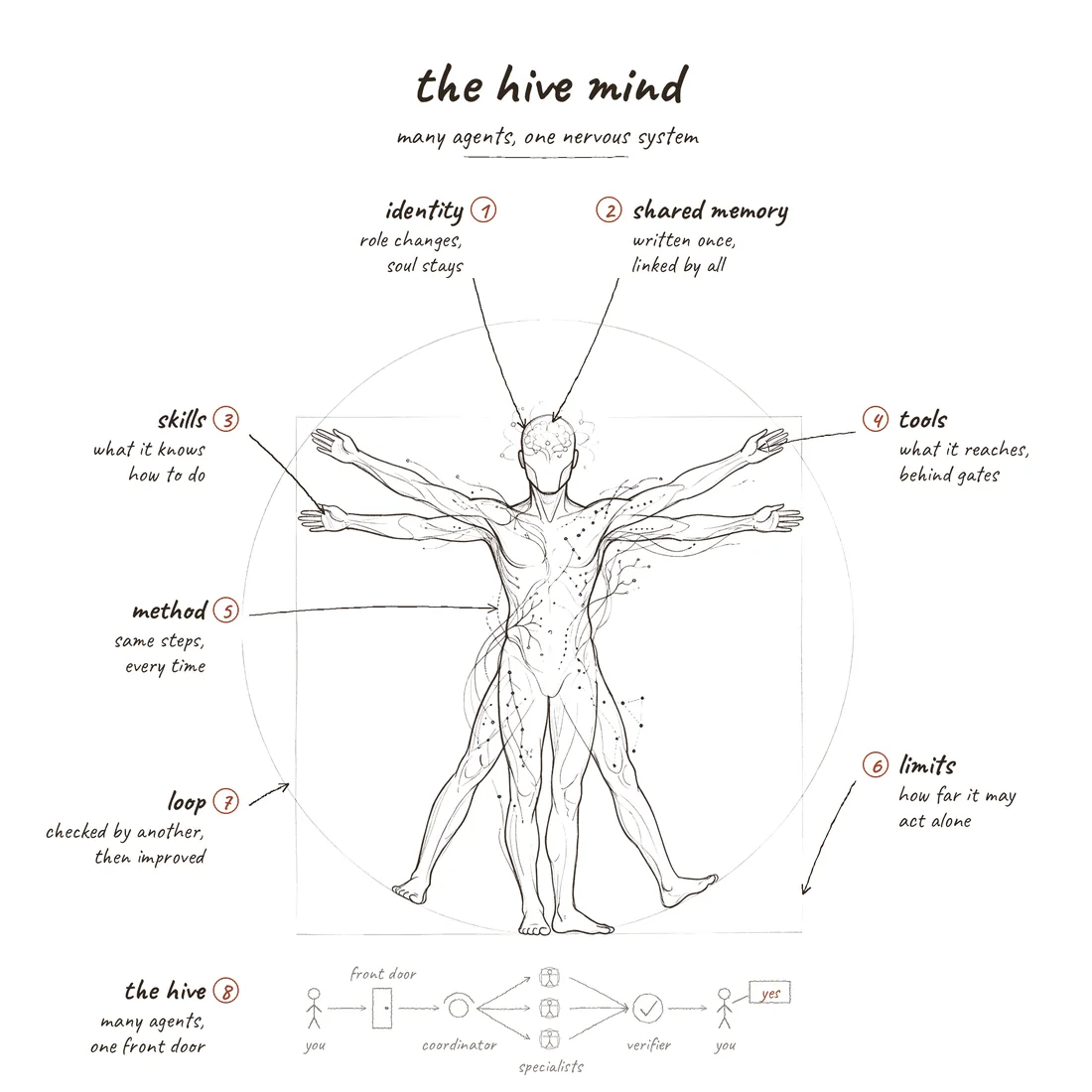
I begin where nature began, with a body. The head holds identity and memory, the hands hold skills and tools, the spine carries method, and around it stand its limits and its loop. One body can think, but many bodies need a hive, and a nervous system to turn that hive into one mind.
The hive mind, in build order
- Identity
Who the agent is, kept apart from what it does.
- Shared memory
What every agent knows, and how it reads it.
- Skills
What it knows how to do, tested before it is trusted.
- Tools
What it can reach, and what stops it.
- Method
The same steps, in the same order, every time.
- Limits
How far it may go on its own.
- The loop
How work gets checked, and how the agent improves.
- The hive
Many agents, one front door.
- The nervous system
My proposal for what turns a team into one body.
1. Identity
Identity lives in two small files. The role is the function: what the agent is for, what it takes in, what it returns, and what it must never do. The soul is the voice, and nothing more.
Precision here is measurable. In a study of 1,642 multi-agent traces, agents ignoring their task specification was one of the most common failures, and clearer role specifications alone raised one system's success rate by 9.4 points, with the same model and prompt.
A persona is not power. Tests across many personas found no reliable gain on objective questions: a persona changes the tone, not the accuracy. So when the role and the soul disagree, the role wins, and you add a test that proves it. The role sets the law, and the soul sets the tone.
2. Shared memory
Memory lives in two places. Each agent keeps its own brain, deep expertise stored with its sources, and the whole team shares one set of rules, written once and linked by all.
No mind reads its whole library at once. It reads a map, then a small bundle, and then only what the task demands. Anthropic calls this context engineering, and the reason is measurable: Across 18 models, performance fell as the input grew longer. More is not more, and focus is force.
Every fact carries its origin, with one of four seals: raw for a kept source, fetch for something read this run, search for something found but not checked, and infer for something reasoned from evidence. Search can find, but only a source can prove.
Memory is also the first target of an attack. In one study, poisoning less than a tenth of a percent of an agent's memory gave attackers over 80 percent success. So there is one writer per file, and nothing enters unchecked. Guard what it knows, or lose what it is.
3. Skills
A skill is knowledge made repeatable: inputs go in, one output comes out. When a decision is missing, it returns "needs input". When evidence is missing, it returns "no data". A skill may stop, but it may never guess.
Focused skills work. In the first large skills benchmark, curated skills raised the average pass rate from 33.9 to 50.5 percent. But in 16 of 84 tasks a skill made the results worse, and skills a model wrote for itself gave no benefit on average.
So measure every skill, with it and without it, before it touches real work. Claude Code's own documentation makes the same point: seeing a skill trigger tells you it was found, not that it did what you intended. And remember that a skill is knowledge, not permission. Know-how is not allow-how.
4. Tools
Tools are what an agent can reach, but reach is not permission, and every tool starts at none. Each tool names who may use it. Spending and writing each need their own human yes. Keys are stored by name, never by value, and the budget is set before the first call.
Danger rarely lives in one tool. It lives in the combination of private data, untrusted content and a way to send things out, which Simon Willison named the lethal trifecta. Hold two, and never all three.
5. Method
Method is the spine: the habits every agent shares, a production line for every deliverable, and templates, so every output keeps its shape.
Why such discipline? Because consistency is the rarest property in an agent. In 2024, the best tool-using agents on the τ-bench benchmark succeeded on under half of the tasks. Models have improved since, but the lesson holds. The work follows fixed steps, with a review gate, an approval gate and a rule for when to stop, and then you run it again and again. What works once is chance, and what works each time is design.
6. Limits
Limits are the square around the body. The ceiling is the most an agent may do without asking, and the switch decides if it runs at all. Both start at none and off.
Then come three rungs. Private and undoable work can go. Public work needs a standing yes. Anything costly or final needs a fresh yes, every time. And a yes covers one exact item: change one word, and the seal breaks.
Every system has a weak point, and in approvals it is us. Anthropic reports that people accept 93 percent of manual permission prompts. So make every request quick to judge, and spend your attention where it matters, because a yes given by habit is no yes at all.
7. The loop
The loop is how work gets checked, and how the system learns. Its first law is that no author approves its own work. Agents grade themselves too kindly, so a separate verifier checks the exact version.
It runs on test briefs, a rubric and attack cases, and it runs each one more than once, because a lucky pass and a reliable one look the same until you repeat them. Every mistake becomes a lesson, but only a human turns a lesson into a rule. The agent may learn, but it may never legislate.
8. The hive
Now, many agents. You speak to one front door, a coordinator picks the specialists, a verifier checks the work, and then it comes back to you. Every handoff uses one form and ends in one status, completed, partial, blocked, failed or cancelled, and never blurred into done.
And yet, you begin with one. Anthropic measured multi-agent systems using about 15 times the tokens of a chat, and on popular benchmarks the gains are often minimal. Grow the hive when the work requires it, not when the mind desires it.
9. The nervous system
Shared rules make a team, but they do not make one body. For that, a system needs nerves. This part goes beyond the research: it is my proposal, in four pieces.
- A live board that everyone reads, built from the records, so it can never drift from reality.
- Borders, where another agent's output is data to read, never orders to follow. This is the least solved problem in the field: adaptive attacks bypassed 12 published defences.
- A bell, so a stuck agent calls the coordinator first, and then you.
- A trace, because what you cannot replay, you cannot trust.
The build order
Nine parts, and one law: a written rule can guide, but only enforcement can decide. So build it one layer at a time. One agent, then skills, tools, method, limits, the loop, the team and the nerves, and prove each layer before you add the next.
Frequently asked questions
What is the hive mind?
A way to design AI agents in nine layers, like a body: identity, shared memory, skills, tools, method, limits, the loop, the hive, and the nervous system that joins them.
Do I need many agents?
No. Begin with one. Multi-agent systems burn about 15 times the tokens of a chat, and on popular benchmarks the gains are often minimal. Grow the hive when the work requires it.
Should I give my AI a persona?
A persona changes the tone, not the accuracy. Write the role first: what the agent is for, what it takes in, what it returns, and what it must never do. When the role and the soul disagree, the role wins.
Do skills make an agent better?
Often, but not always. Curated skills raised the average pass rate from 33.9 to 50.5 percent in the first large benchmark, yet 16 of 84 tasks scored lower with a skill. Test every skill with it and without it.
How do I keep an agent safe?
Every tool starts at none, spending and writing each need their own human yes, and no agent should hold private data, untrusted content and a way to send things out at the same time. Another agent's output is data to read, never orders to follow.
Is the research guide free?
Yes. The full guide is 42 pages with all 85 sources, free to download as a PDF from this page.
Methodology and disclosure
This article follows my video and the Hive Mind research guide. Every number here comes from a source cited in the guide, each measured on its own benchmark or system, not on yours. Part 9, the nervous system, goes beyond the research and is my own proposal. This article was drafted with Claude Code from the video script and the guide, then checked against the guide's sources before publishing. Independent work, not affiliated with or endorsed by Anthropic, OpenAI, Google, OWASP or NIST. Written by Agrici Daniel. To report an error, contact me in the AI Marketing Hub community and I will correct it.