Black Friday Pricing Math: 1 Formula and 6 Steps (No Guessing)
At 50% margin, 40% off means you need 5x the sales just to keep the same gross profit. The 1 formula, 6 steps, EU and US price rules, and my own $999 annual deal math.

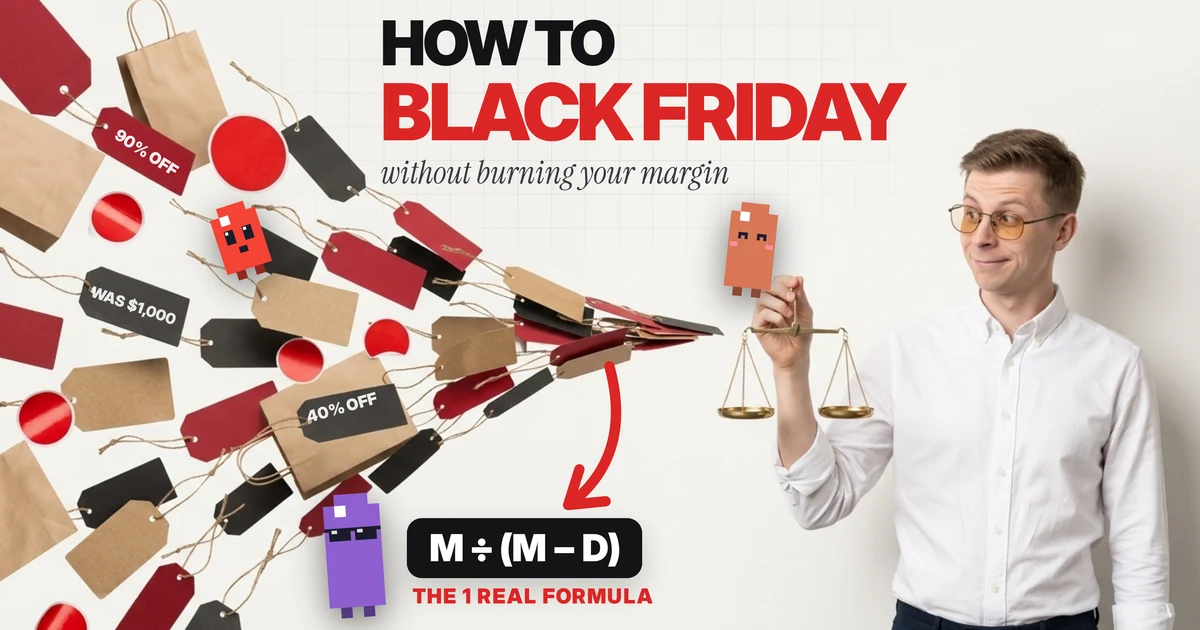
Before you pick a Black Friday discount, run one formula: Needed sales = Margin / (Margin - Discount). At a 50% gross margin, taking 40% off does not mean you need 40% more orders. You need 5 times as many sales just to make the exact same gross profit you made before the sale. If your discount reaches or passes your margin, every order loses money.
Most small businesses pick a discount that feels generous, put it on a banner, and hope volume saves them. I asked my AI team (the Homies) to break down the math, the pricing rules in the EU and US, and the six steps behind a profitable Black Friday deal, then run my own AI Marketing Hub Pro annual offer through the same system live. Everything below uses the verified numbers from the video, with primary sources linked next to each claim. Where I walk through my own Pro offer, read that as a business owner showing his own arithmetic, not financial advice.
- 5.0xsales needed to break even on 40% off at 50% margin
- $79Bglobal online Black Friday 2025 sales (Salesforce)
- 100%of 175 UK appliance deals same price or cheaper elsewhere (Which?)
- +693%generative AI traffic to US retail sites YoY (Adobe)
- $999worked annual Pro deal (vs $1,440 annual, $144/mo)
Watch the 6-minute Deal Lab
In the video, Coral, Violet, and Red walk through the cold-open sweater math, the break-even formula for physical shops, digital products, and subscriptions, the EU and US price rules, and the live build of my own Black Friday offer.

Key takeaways
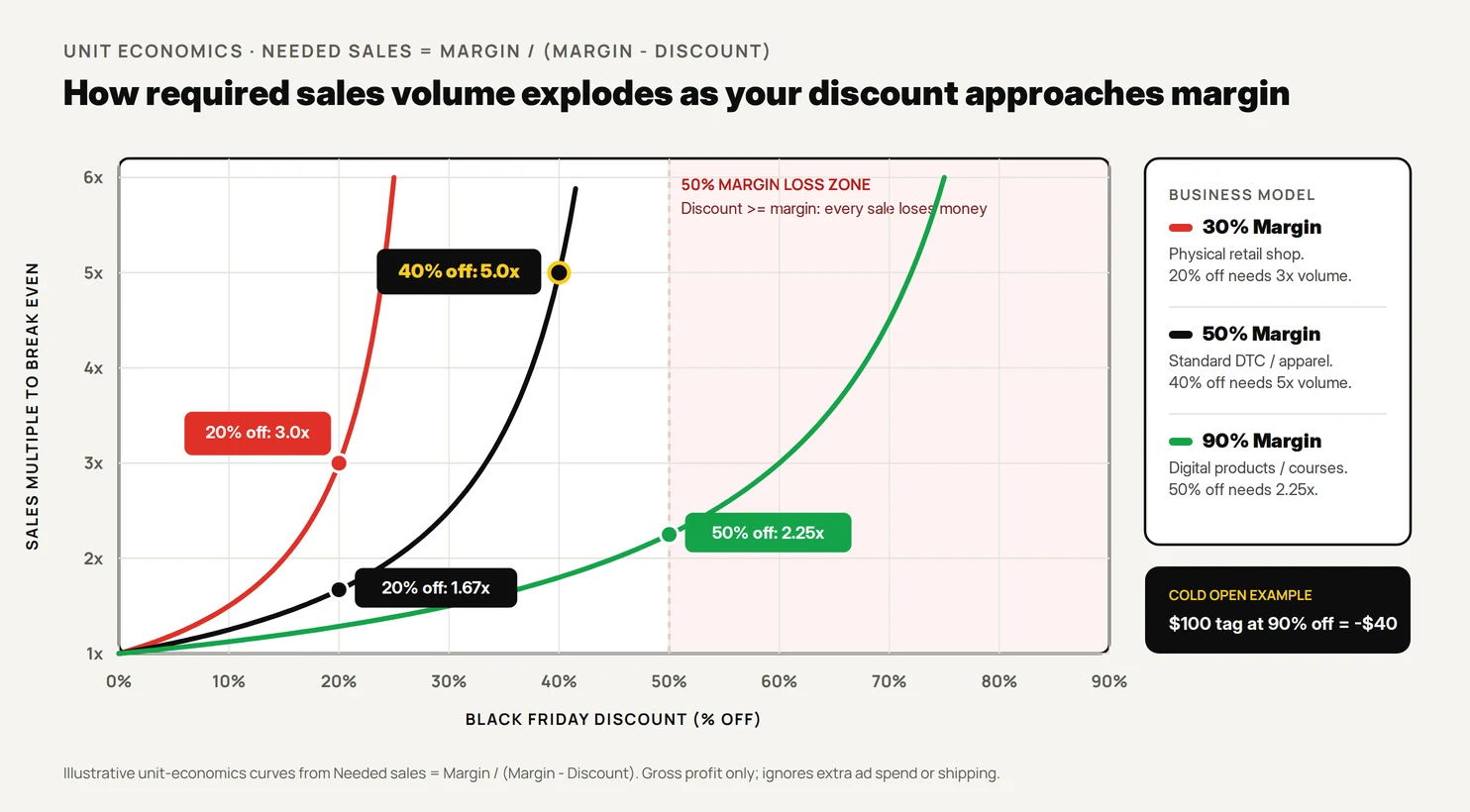
- Run the break-even multiple before touching a price tag. Divide your gross margin by (Margin minus Discount). At 50% margin, 20% off needs 1.67x sales; 40% off needs 5.0x sales.
- Pick one goal first. A deal designed to clear physical stock looks nothing like a deal designed to lock in annual subscribers.
- Match the deal shape to your margin. Low-margin physical shops (around 30%) protect profit better with bundles or spend thresholds; high-margin digital products (around 90%) have room for clean cuts; subscriptions win by discounting annual plans, not month one.
- Frame the same savings better with the Rule of 100. Under $100, show a percentage off. Over $100, show the dollar amount off.
- Never invent a fake "was" price. EU law requires showing the lowest prior price from the last 30 days on goods, and US FTC guides require a bona fide former price. Shoppers check price history now.
- Publish your real offer terms in plain text. Generative AI shopping traffic to US retail sites jumped 693.4% in the 2025 holiday season. AI assistants read clean offer text, not hidden coupon graphics.
Why guessing a discount breaks profit
Black Friday is loud enough to make any small business panic into copying the biggest percentage sign on the street. On Black Friday 2025, US shoppers spent $11.8 billion online, up 9.1% year over year (Adobe Analytics). Globally, online Black Friday 2025 sales reached $79 billion, up 6% (Salesforce), and stores on Shopify hit a peak of $5.1 million in sales per minute together (Shopify).
Even the name gets misunderstood. Retailers love repeating the story that Black Friday is the day accounts flip from red ink to black ink. That story is a 1980s rebrand. The name originated with Philadelphia police in the 1950s to describe the traffic and shoplifting chaos the day after Thanksgiving, and caught on locally by 1961 (History.com). Most small shops do not flip into profit by slashing prices blindly. They lose margin on every unit.
Take the $100 sweater from the opening of the video. At a 50% gross margin, that sweater costs you $50 to make and stock. Cut the price by 90% and it sells for $10, which means you lose $40 on every sweater that leaves the building. Even at 80% off ($20), you still lose $30 per sale. You cannot make up a negative margin on volume.
The 1 formula to run first
You only need one piece of arithmetic to check whether a discount makes sense before you launch it:
Needed sales multiple = Margin / (Margin - Discount)Every variable uses percentages (or decimals) of the normal selling price. The output tells you how many times your normal unit volume you must sell during the promotion just to walk away with the same total gross profit dollars. Not more profit. The same profit.
Break-even volume
Sales multiple required just to keep the same gross profit
| Business example | Gross margin (M) | Discount (D) | Profit left per sale | Sales needed to break even |
|---|---|---|---|---|
| Standard retail (light cut) | 50% | 20% | 30% of original price | 1.67x (+67%) |
| Standard retail (deep cut) | 50% | 40% | 10% of original price | 5.00x (+400%) |
| Standard retail (cold open) | 50% | 90% | -$40 on a $100 item | Impossible (loss on every sale) |
| Physical shop | 30% | 20% | 10% of original price | 3.00x (+200%) |
| Digital product or course | 90% | 50% | 40% of original price | 2.25x (+125%) |
Notice what happens when you move from 20% off to 40% off at a 50% margin. You doubled the discount, yet your break-even sales target jumped from 1.67x to 5.00x. That is why copying a competitor's "40% OFF" banner without knowing their cost structure can turn your busiest weekend of the year into your least profitable one.
The 6 steps behind a profitable deal
Once the formula sets your guardrails, designing the promotion becomes a short sequence instead of a guessing game.
The Deal Lab blueprint
Six steps from margin check to launch
- Pick one goal
Decide whether you want to clear aging stock, raise average order value, acquire first-time buyers, or lock monthly members into annual plans. One offer cannot optimize all four at once.
- Run the formula
Plug your real gross margin (after product cost, payment fees, and fulfillment) into Margin / (Margin - Discount) so you know the exact volume multiple required to stand still.
- Pick the deal shape
Choose the mechanic that fits your margin: bundles and thresholds for physical shops, clean cuts or bonuses for digital products, annual lock-in for subscriptions.
- Frame the number
Apply the Rule of 100 so the same real savings reads clearly without trickery.
- Make it true
Use real prior prices that hold up under EU 30-day rules, US FTC guides, and basic customer price-tracking extensions.
- Say it plainly, and email warm buyers first
Put your exact price, dates, and terms in clean text on the offer page for both human shoppers and AI shopping agents, and notify your existing audience before fighting for cold ad traffic.
Match the deal to your business model
A blanket percentage off is only one tool, and for many businesses it is the weakest one.
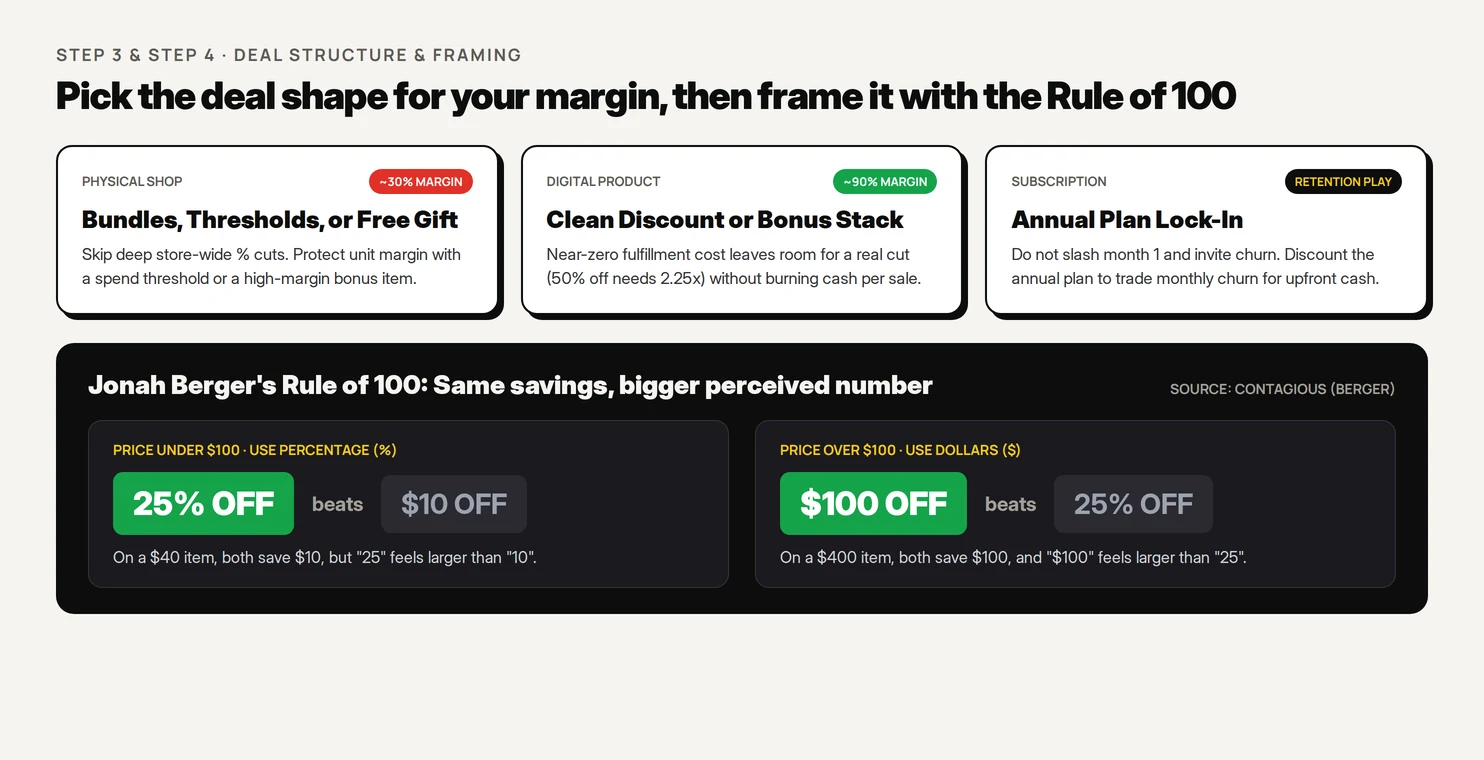
- Physical shops (around 30% margin). Cutting 20% off forces 3x normal unit sales before you earn one extra dollar of gross profit. Better shapes: tiered spend thresholds (spend $150, get $25 off), curated bundles that pair slow stock with bestsellers, or a free gift with purchase whose perceived value is high while its landed cost is low.
- Digital products and courses (around 90% margin). Fulfillment cost per extra buyer is close to zero. Cutting 50% off still leaves 40% of the list price and requires 2.25x sales to break even. A clean discount or a time-boxed bonus workshop works well here without wrecking unit economics.
- Subscriptions and communities. Discounting the first month of a monthly plan attracts deal-hunters who cancel on day 29. Instead, leave the monthly price alone and discount the annual plan. You trade unpredictable monthly churn for committed members and year-one cash upfront.
Frame the number with the Rule of 100
Once your math is locked, presentation changes how clearly buyers feel the value without changing a cent of your margin. Wharton professor Jonah Berger popularized the Rule of 100 in Contagious (Jonah Berger): under $100, a percentage discount looks larger; over $100, an absolute dollar discount looks larger.
- On a $40 product: 25% off and $10 off give the buyer the exact same $10 discount. "25% off" looks bigger because 25 is larger than 10.
- On a $400 product: 25% off and $100 off both save $100. "$100 off" looks bigger because 100 is larger than 25.
Notice what this rule does not do. It does not invent fake value or hide fees. Both framings describe the exact same transaction; you are choosing the clearer label.
Make it true: EU, US rules and fake discounts
Shoppers have learned to distrust Black Friday banners because too many "was" prices are theater. Consumer group Which? tracked 175 home, tech, and health appliance deals across eight UK retailers for a full year from May 2024 to May 2025 (published November 25, 2025). Every single one of those 175 deals (100% of the tracked sample) was the same price or cheaper at other times of the year. That finding covers those 175 tracked appliance deals, not every Black Friday offer on earth, yet it shows why buyer skepticism is earned.
Regulators do not treat inflated reference prices lightly either:
- In the European Union: Directive (EU) 2019/2161 (article 6a, amending the Price Indication Directive for goods) requires any announced price reduction on a product to display the prior price, defined as the lowest price applied by the trader during a period not shorter than 30 days before the reduction (with limited national variations for perishables, newly listed goods, and progressive cuts).
- In the United States: The FTC's Guides Against Deceptive Pricing (16 CFR 233.1(a)) state that a former price comparison is legitimate when the former price was an actual, bona fide price at which the item was offered to the public on a regular basis for a reasonably substantial period of time.
Raising a price on Thursday so you can slash it 90% on Friday violates both the spirit of trust and, depending on what and where you sell, the rules on deceptive pricing. State your real normal price, state the deal price, and state when the window closes.
Who hears first and why plain-text pages matter
Ad auctions spike during Black Friday week. Your cheapest, highest-converting channel is the audience that already knows your work: your email list, your community, and your past buyers. Tell them first, clearly, without countdown tricks.
There is also a newer buyer sitting on the other side of your offer page: AI shopping assistants. According to Adobe Analytics, traffic from generative AI tools to US retail sites during the 2025 holiday season (November 1 to December 31) rose 693.4% year over year. When someone asks ChatGPT, Perplexity, or Gemini to compare Black Friday deals in your category, an offer buried inside an image-only pop-up or a mystery coupon wheel is invisible. Write your normal price, sale price, eligibility, and closing date in plain HTML text on your offer page. (For more on how AI assistants read pages, see AI SEO in 2026.)
My own Black Friday deal: the live audit
In the second half of the video, I put my own product through the exact same six steps so you can inspect the numbers rather than taking theory on faith.
Product: AI Marketing Hub Pro (skills, workflows, live calls, and the systems I build and run). Normal pricing is $144/month or $1,440/year.
- Step 1 (Goal): Reward people who commit for a full year, instead of discounting month one and inviting short-term churn.
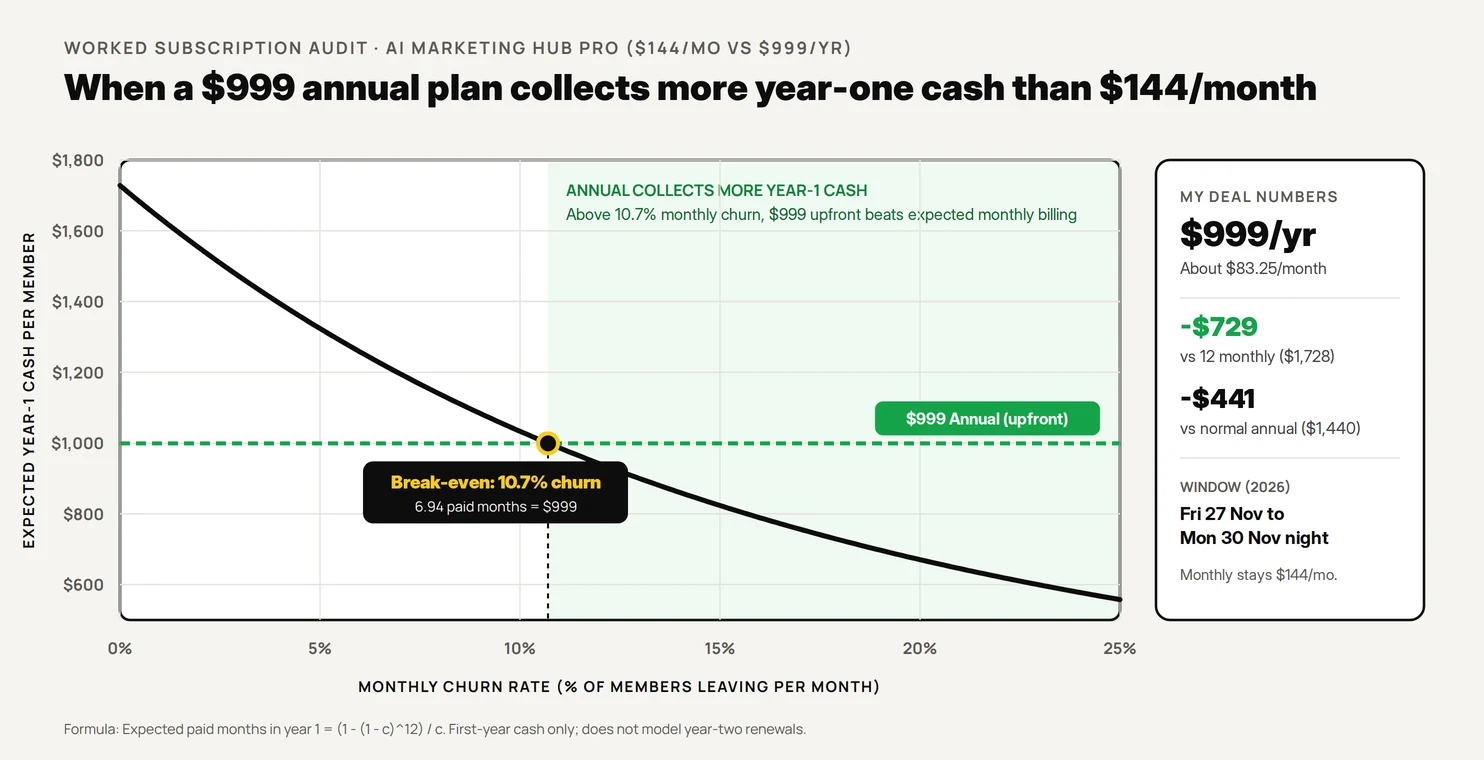
- Step 2 (The math): Instead of cutting $144/month in half ($72/month), I keep monthly at $144 and set the Black Friday annual plan to $999 for the year (about $83.25/month). That equals 6.94 months of monthly payments ($999 / $144). Using expected paid months in year one at monthly churn rate
c,(1 - (1 - c)^12) / c, collecting $999 upfront brings in more year-one cash than monthly billing whenever monthly churn exceeds 10.7% (about 11 in 100 members per month). - Step 3 (Deal shape): Annual plan only. Monthly pricing stays $144/month.
- Step 4 (Framing, Rule of 100): Because the price is well over $100, I lead with dollars saved and show both benchmarks clearly: $729 less than 12 monthly payments ($1,728, or 42.2% off) and $441 less than the normal annual price ($1,440, or 30.6% off).
- Step 5 (True window): Opens Friday, November 27, 2026, and closes Monday night, November 30, 2026. After Monday night, it returns to $1,440/year.
- Step 6 (Plain text): Every price and benchmark is written plainly on the Skool page and right here, with zero hidden tiers.
| Plan | Total cost (12 months) | Monthly equivalent | Savings vs 12 monthly | Savings vs normal annual |
|---|---|---|---|---|
| Monthly (unchanged) | $1,728 | $144.00/mo | $0 | -$288 |
| Normal annual | $1,440 | $120.00/mo | $288 (16.7%) | $0 |
| Black Friday annual (Nov 27 to Nov 30 night) | $999 | $83.25/mo | $729 (42.2%) | $441 (30.6%) |
Methodology and limits
- Gross profit only. The formula
Margin / (Margin - Discount)measures unit gross profit before fixed overhead, seasonal ad CPM inflation, shipping spikes, and return rates. Include variable payment processing and fulfillment fees inside your margin input before running it. - First-year cash only on the churn curve. The 10.7% churn crossing point models year-one cash collected. Year-two renewals, support load, and refund rates are separate variables you should check in your own billing history.
- Educational math, not legal or financial advice. The EU Directive and FTC Guides links above are primary references for general orientation; verify local consumer-pricing rules with qualified counsel for your jurisdiction and product category.
- First-party disclosure. I own AI Marketing Hub Pro. Run your own numbers and check everything listed on the Skool page before deciding whether Pro fits your work.
Frequently asked questions
What is the Black Friday break-even discount formula?
Divide your gross margin by your margin minus the discount: Needed sales multiple = Margin / (Margin - Discount). For example, at a 50% margin and a 40% discount, 0.50 / (0.50 - 0.40) = 5.0, meaning you need 5 times as many unit sales just to make the same gross profit.
Why does a 40% discount hurt a 50% margin business so much?
Because the discount comes straight out of your profit, not your product cost. On a $100 item that costs $50 to make, your normal profit is $50. Taking 40% off drops the price to $60 and cuts your profit per unit from $50 down to $10, which is one-fifth as much profit per sale.
What Black Friday deal works best for a low-margin physical shop?
At a 30% margin, even 20% off requires 3x normal unit volume to break even. Spend thresholds, product bundles, or a free gift with purchase protect your per-order margin far better than a store-wide percentage cut.
What is the Rule of 100 for discounts?
Jonah Berger's Rule of 100 states that for items priced under $100, a percentage discount seems larger (25% off feels bigger than $10 off on a $40 item), while for items over $100, an absolute dollar discount seems larger ($100 off feels bigger than 25% off on a $400 item).
What are the rules on "was" prices for Black Friday?
In the EU, Directive 2019/2161 (article 6a) requires price-reduction notices on goods to show the lowest prior price applied over at least the previous 30 days, subject to narrow member-state exceptions. In the US, FTC Guides Against Deceptive Pricing (16 CFR 233.1) expect a former price to be a real, bona fide price offered regularly for a reasonably substantial period.
What is the AI Marketing Hub Pro Black Friday offer?
The annual plan is $999 for the year (about $83.25/month), down from the normal $1,440 annual price ($441 less) and $729 less than 12 monthly payments at $144/month. Monthly pricing stays $144/month. The offer opens Friday, November 27, 2026 and closes Monday night, November 30, 2026.
Related reading
- AI SEO in 2026: What Changed, What Didn't, and What to Do Now
- Claude Code for Marketing: The Full System I Built (17 Roles, 139 Skills)
- AI Marketing Automation: The Open-Source Stack I Use Daily
- Claude Code Just Replaced Your Ad Agency: 250+ Checks in One Command
Black Friday 2026 · Nov 27 to Nov 30 night
Run your numbers first. Then look inside Pro.
Check your own margin with Margin / (Margin - Discount). If you want the AI marketing skills, workflows, live calls, and systems I run every day, the AI Marketing Hub Pro annual plan is $999 for the year instead of $1,440 from Friday Nov 27 through Monday night Nov 30.
Share this article
Keep reading.
All 49 posts
AI Marketing Automation: The Open-Source Stack I Use Daily
My entire AI marketing stack costs roughly $50/month in API calls. Here's every tool, how they connect, and why I stopped paying for Ahrefs.
14 min read

AI News This Week: Nvidia's CEO Resigns, Anthropic Sets IPO Terms, Four New Models
Nvidia's CEO resigned, Anthropic set IPO terms, four AI models shipped, ChatGPT opened business profiles and Google began a core update. What to do about each.
9 min read

The BBC Disclosed Its AI 2027 Video Three Ways. One Shot-Level Gap Remained.
The BBC labeled its AI-generated footage three ways. A frame-by-frame case study found that the shot-level caption stops at 05:22, while generated footage returns later.
26 min read