How I Got 8,000 GitHub Stars in 9 Months as a Solo Developer
By Agrici Daniel | April 10, 2026
8,135 GitHub stars across 26 repos in 9 months. No team, no funding. The exact channels, README tactics, and ecosystem strategy that worked - with real numbers.

GitHub Has Over 1 Billion Repositories. 99% Have Zero Stars.
GitHub crossed 1 billion repositories in June 2025 (Kinsta, 2026). Over 180 million developers use the platform. And the vast majority of projects sit at zero stars, zero forks, zero downloads. I know because my first repos were in that category. Then something changed.
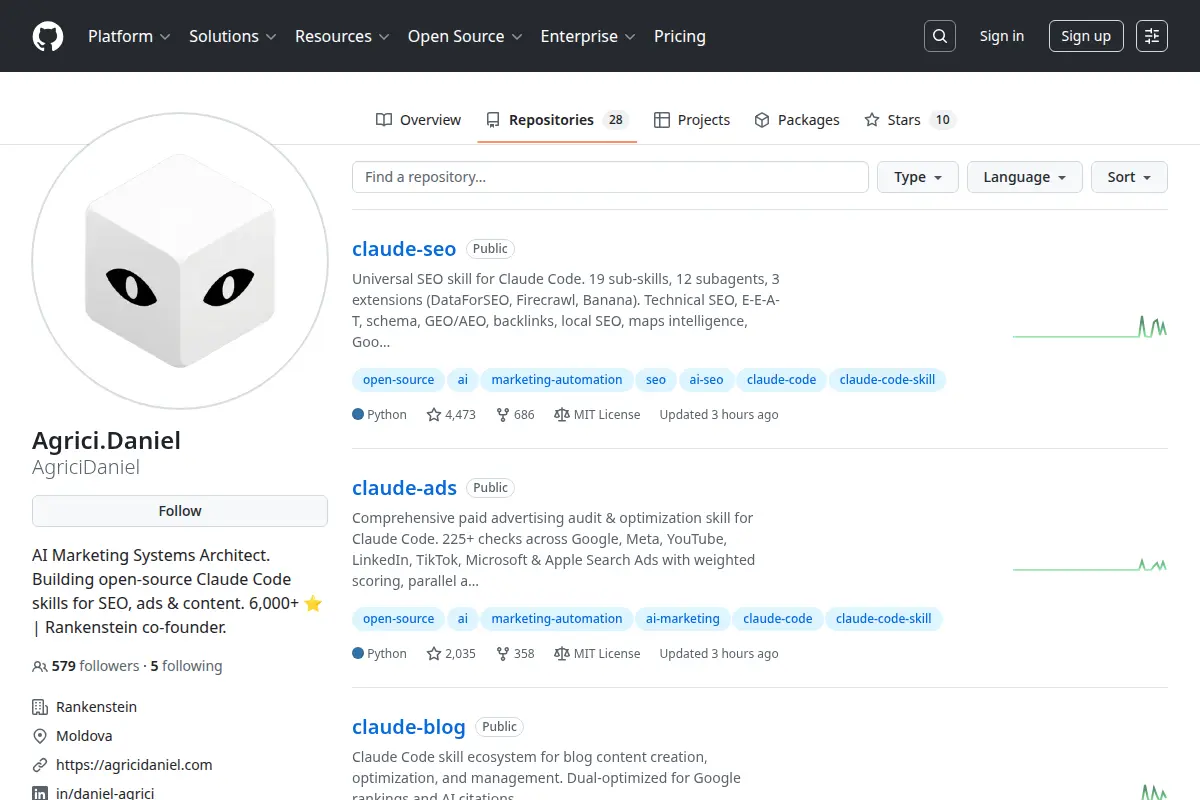
Between October 2025 and April 2026, I built 26 open-source tools - Claude Code skills for SEO, advertising, content, knowledge management, and video - and accumulated 8,135 GitHub stars and 1,412 forks. No team. No VC. No marketing budget. Just one developer solving real problems with AI automation.
This isn't a guide about gaming algorithms. It's the exact timeline, the channels that worked, the mistakes I made, and the one strategy that turned 26 scattered repos into a compounding growth engine.
Key Takeaways
- 8,135 stars across 26 repos in 9 months, with claude-seo alone hitting 4,466 stars and 685 forks
- 73% of engineering teams now use AI coding tools daily (Developer Survey, 2026) - building for this wave drove organic discovery
- YouTube demos, the Skool community, blog content, and organic GitHub discovery drove 80%+ of growth - not Product Hunt launches or paid ads
- The ecosystem strategy (26 tools that cross-reference each other) compounds faster than any single product
What Do 8,135 Stars Across 26 Repos Look Like?
Most open-source case studies are about one project. AFFiNE grew to 60K stars (DEV.to, 2026). ScrapeGraphAI hit 20K. But they're teams with funding and full-time employees. My approach was different: build 26 tools that form an ecosystem, not one product that does everything.
The power law is obvious. The top 2 repos - claude-seo and claude-ads - account for 80% of total stars. But here's what the chart doesn't show: the smaller repos feed the larger ones. Someone discovers claude-obsidian, sees it links to claude-seo, stars both. That's the ecosystem effect.
The numbers: 8,135 total stars, 1,412 forks, 577 followers, 26 public repos. Account created July 27, 2025. First repo (n8n workflow) published October 31, 2025. That's roughly 9 months from zero to here. Every star count in this article is live, verifiable data from github.com/AgriciDaniel.
What Was the Growth Timeline?
ScrapeGraphAI took 6 months to hit 1,000 stars, then reached 10,000 in the next 4 months (ScrapeGraphAI, 2026). Growth compounds once you find the right audience. My timeline followed a similar pattern - slow start, then a sharp inflection.
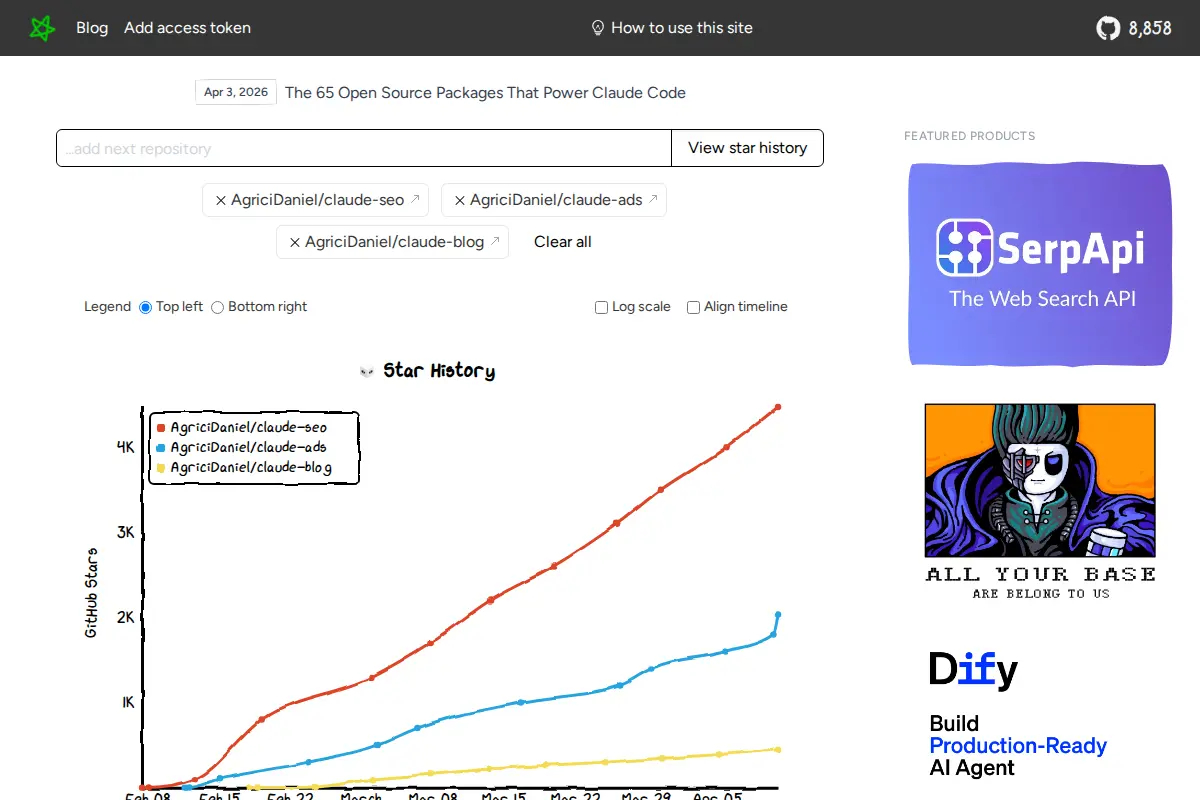
Phase 1 (Oct-Nov 2025): Three n8n automation workflows. Modest traction - about 170 stars combined. These were the "learning in public" phase. They taught me what developers wanted: tools that solve real problems, not demos.
Phase 2 (Jan 2026): Pivoted to Claude Code skills. Built on-page-seo, linkedin-content-creator, and planckatron. Around 300 cumulative stars. Still small, but the Claude Code ecosystem was heating up.
Phase 3 (Feb 2026): The explosion. claude-seo launched February 7th. claude-ads four days later. claude-blog, skill-forge, claude-prompts, and claude-shorts followed the same month. I went from 300 to 5,500+ stars in a single month. This wasn't luck - it was timing plus preparation. Claude Code was becoming the most-used AI coding tool (46% "most loved" in the Pragmatic Engineer survey), and I had the most comprehensive skill library.
Phase 4 (Mar-Apr 2026): Sustained growth. banana-claude, claude-obsidian, and the content tools added another 2,600+ stars. The ecosystem was compounding - each new tool brought users to the existing ones.
The inflection moment: When claude-seo hit GitHub Trending, I watched the star count climb in real time - hundreds per hour. But the real growth came from what happened next: people who starred claude-seo explored my profile, found claude-ads, found claude-blog, and starred those too. A single trending moment cascaded across the entire ecosystem. That's when I realized the strategy was working.
Which Channels Actually Drove Stars?
73% of engineering teams now use AI coding tools daily - up from 41% in 2025 (Developer Survey, 2026). Building tools for this wave meant organic discovery was built into the market. But I still needed to get the first eyeballs. Here's what worked, roughly weighted by impact:
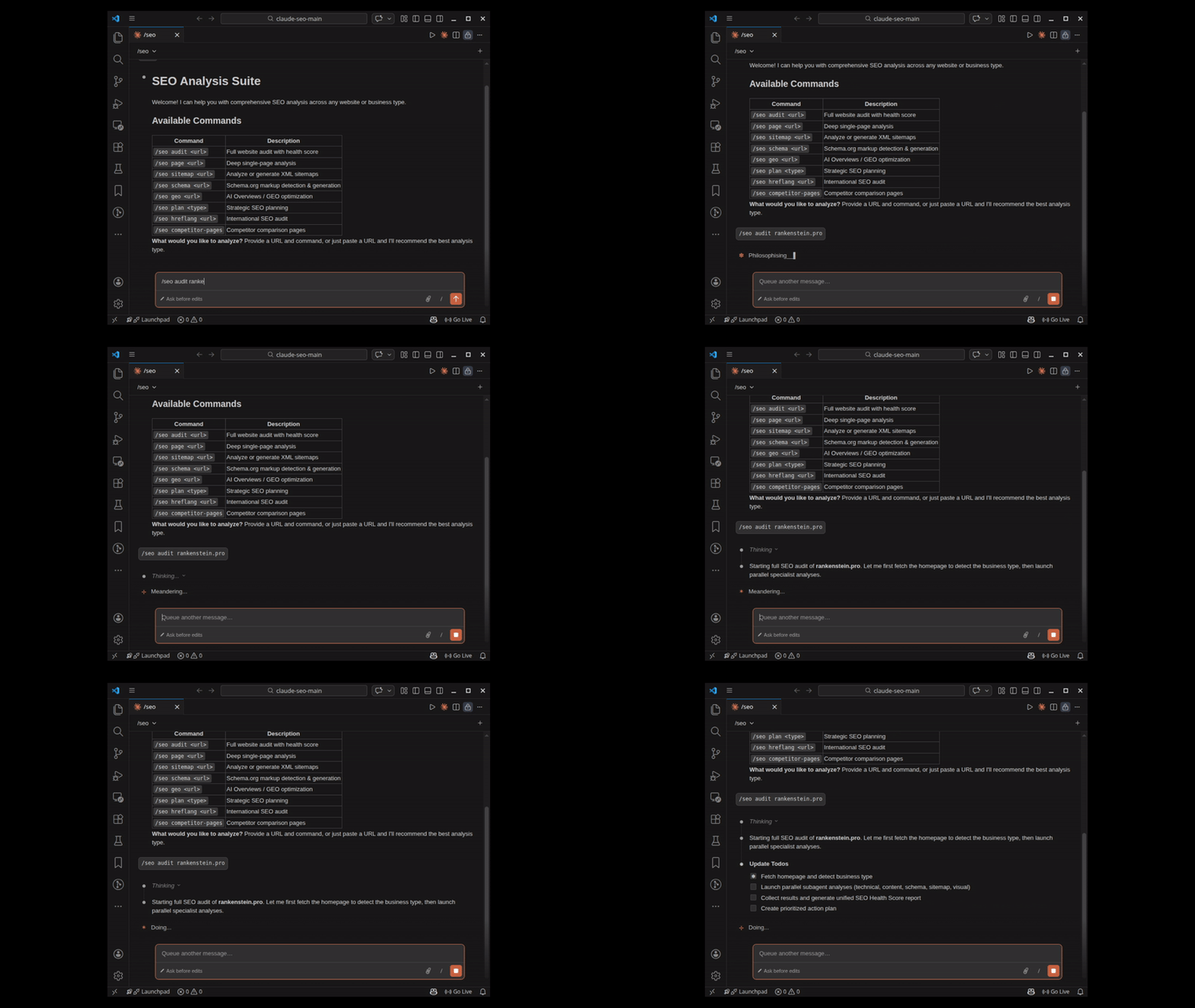
Organic GitHub (~35%): The biggest driver was GitHub's own discovery. When claude-seo hit Trending, it triggered a chain reaction - appearing in "Explore" recommendations, search results, and "Users also starred" suggestions. GitHub's algorithm rewards velocity (many stars in a short period), and the February launch had that velocity.
YouTube demos (~25%): Every major tool got a YouTube demo video. These weren't polished production pieces - just screen recordings showing the tool in action, narrated in real time. The claude-blog demo hit 13,000 views. Video converts better than text because people can see the tool actually working, not just read about it.
Skool community (~20%): The AI Marketing Hub (2,800+ members) is where I share work-in-progress builds, get feedback, and announce releases. Community members who use the tools become evangelists - they share repos in their own networks, write about them on LinkedIn, and star new tools as soon as they launch.
Blog posts (~15%): Each major tool has a dedicated blog post on agricidaniel.com with data charts, competitor analysis, and deep technical walkthroughs. These rank in Google and drive long-tail traffic. The blog post for claude-obsidian led to a comment on Karpathy's LLM Wiki gist, which drove another wave of stars.
Other (~5%): Reddit, LinkedIn, Twitter/X. Useful for spikes, but not the sustained engine. Reddit in particular is hit-or-miss - a well-timed post in r/ClaudeAI can drive hundreds of stars, but the same post in r/programming might get downvoted into oblivion.
How Did the README Strategy Work?
AFFiNE credits README optimization as one of the biggest levers in their growth from 0 to 60,000 stars (DEV.to, 2026). I learned this the hard way. My early repos had bare-bones READMEs - a title, a paragraph, and install instructions. They got almost no stars. Here's what changed:
- Animated GIF banner - Every repo now opens with a GIF or cover image that shows the tool in action. This is the single biggest conversion lever. People scroll, they see it working, they star.
- Badge row - Stars count, license, install command. Social proof at a glance.
- Feature table - Not a wall of text. A scannable table showing what the tool does in 10 seconds.
- One-command install - If someone can't install your tool in one line, they won't try it.
claude plugin install AgriciDaniel/claude-seois the entire setup. - Ecosystem links - Every README links to related tools. This is the cross-pollination engine.
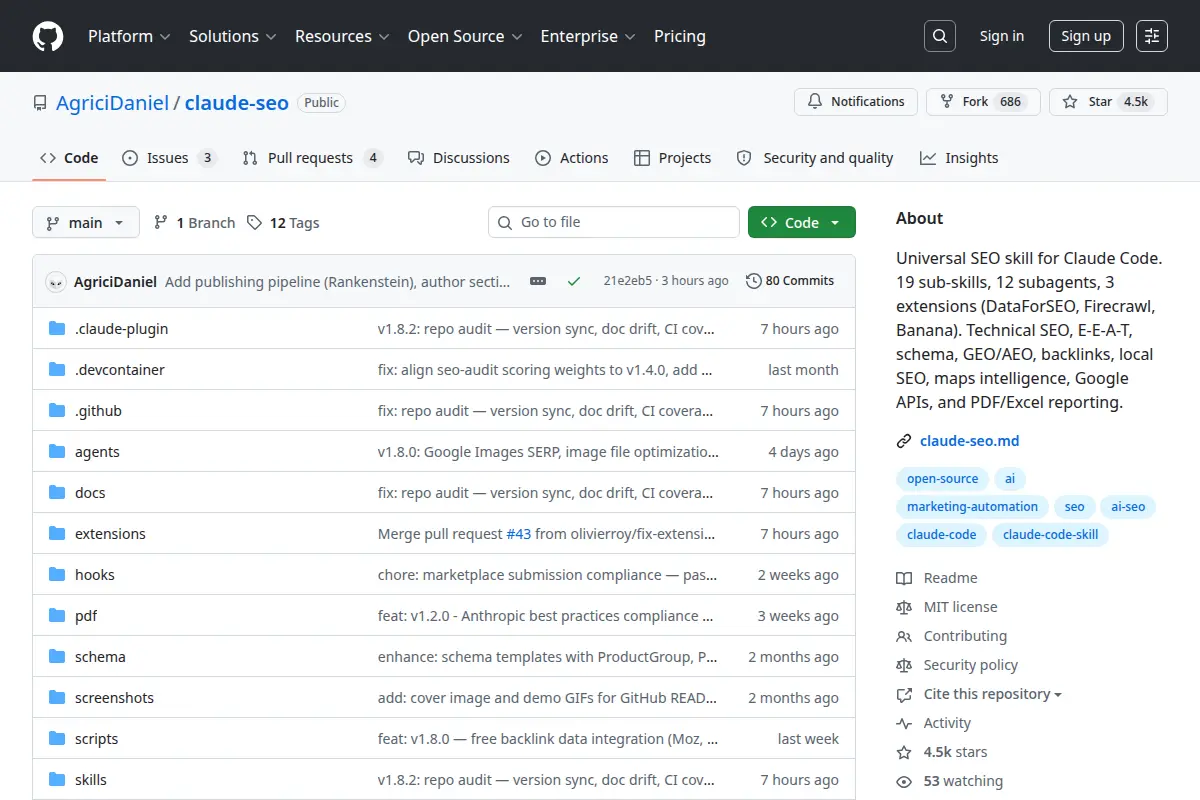
The 30-second test: if a developer can't understand what your tool does, why they should care, and how to install it in 30 seconds of scanning your README - you've lost them. Treat your README like a landing page, not documentation.
Why Does the Ecosystem Strategy Compound?
This is the insight that none of the "how to get GitHub stars" guides cover, because they're all written about single products. I didn't build one tool. I built a supply chain.
Here's how it works: claude-seo audits your site. Its README links to claude-blog for content creation. claude-blog links to banana-claude for AI image generation. banana-claude links to claude-canvas for visual layouts. And all of them link to claude-obsidian for knowledge management.
A developer who finds one tool discovers five.
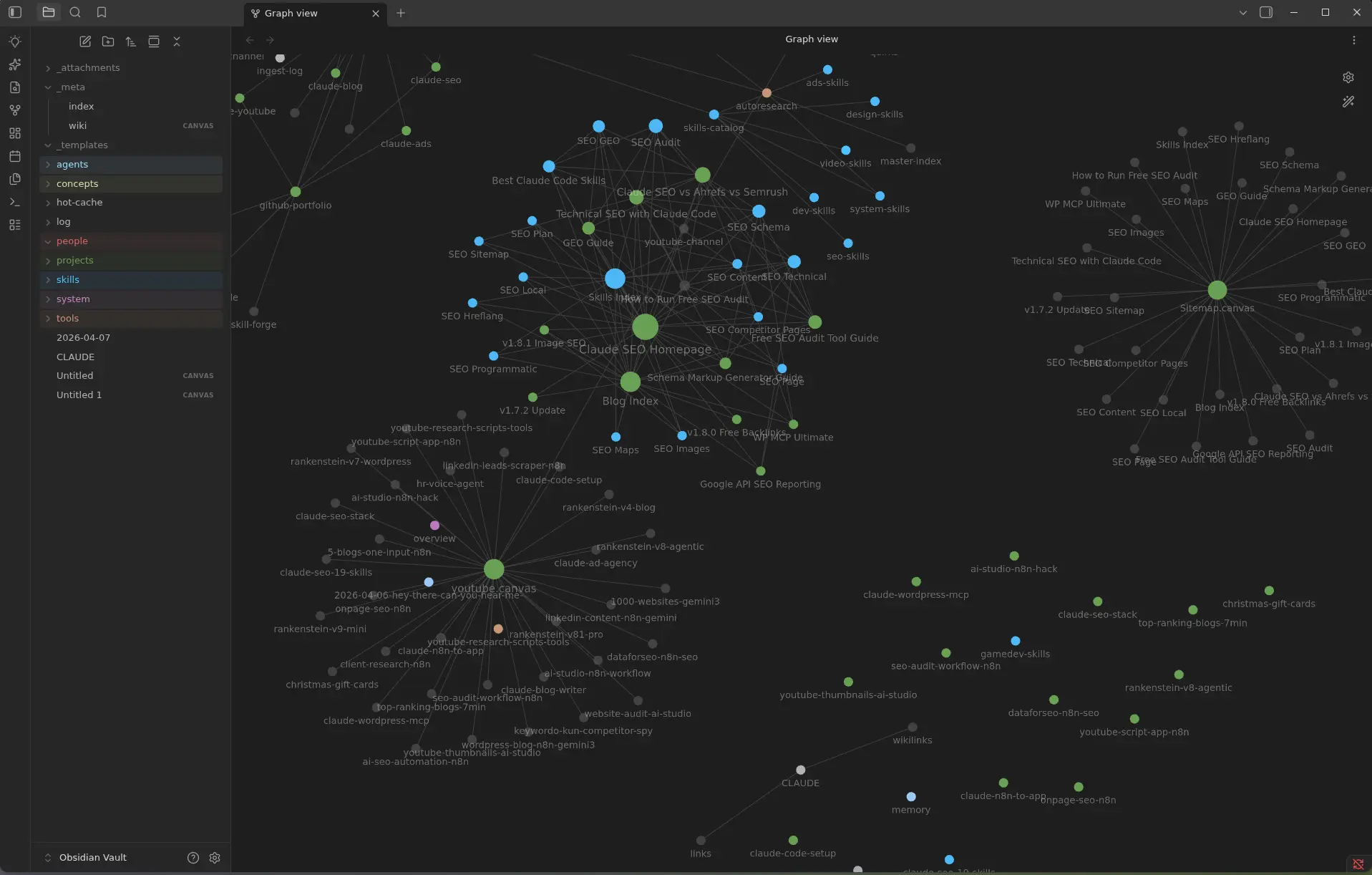
Each new tool I build doesn't just add stars - it multiplies discovery across the entire portfolio. After the backlink update, all 26 repos now cross-reference each other through Author sections, Related Projects tables, and blog post links. That's 87+ internal backlinks creating a web of discovery on GitHub.
The Skool community sits at the center of this web. Users who find the tools join the community. Community members who hear about new tools star them on launch day. This creates the velocity spikes that trigger GitHub's trending algorithm, which creates more organic discovery. It's a flywheel.
The compounding math: If each repo links to 5 others, and someone starring one repo has a 15% chance of starring a linked repo, then adding repo #26 doesn't just add stars to repo #26 - it adds fractional stars to repos #1 through #25. The marginal cost of adding a new tool decreases while the marginal benefit to the ecosystem increases. This is why the portfolio strategy outperforms the single-product strategy at scale.
What Were the Biggest Mistakes?
Not everything worked. Here's what I'd do differently:
- Starting without documentation. My first Claude Code skills had minimal READMEs. They got almost no stars until I rewrote them with proper GIFs, feature tables, and one-command installs. Documentation isn't afterthought - it's the product's marketing.
- Building before validating. A couple of repos exist with under 10 stars because I built what I thought was cool instead of what developers actually needed. The tools that exploded (claude-seo, claude-ads) solved obvious, painful problems. The ones that flopped solved problems nobody had.
- Not building community sooner. I should have started the Skool community in month one, not month four. The community accelerates everything - feedback loops, launch velocity, word of mouth. Every month of delay was compounding opportunity lost.
- Ignoring cross-linking initially. For the first several months, my repos were isolated silos. Once I added ecosystem tables and Author sections linking them all together, discovery increased noticeably. I should have built the network from day one.
Do GitHub Stars Actually Matter?
85% of developers check a project's star count before deciding to use it (ToolJet, 2026). Stars are the first thing a developer sees on a repo page - they're instant social proof. But they're a means, not an end. Here's what stars actually enabled:
- Community growth. Stars drove profile visits, which drove Skool community signups. The AI Marketing Hub grew to 2,800+ members largely through GitHub referrals.
- Product validation. Stars + forks + issues = proof that people use and care about the tools. This informed what to build next - Skill Forge exists because community members asked for it.
- Commercial opportunities. The open-source portfolio led to Rankenstein - an AI content engine built on the same SEO and content principles. Stars = credibility = trust = commercial viability.
- Contributor attraction. 1,412 forks means over a thousand developers took the code and adapted it. Some contributed back. Stars attract talent.
The open source service market is now worth $44.12 billion, growing at 16.22% CAGR (Mordor Intelligence, 2026). If your tools are good enough to get starred, they're good enough to build a business on.
What Would I Tell Someone Starting From Zero?
If you're reading this with zero stars, here's the shortest path I've found:
- Solve a real, painful problem. Not a cool technical demo - a tool that makes someone's daily work easier. claude-seo replaced $300/month in SEO tools. That's why it has 4,466 stars.
- Make your README a landing page. GIF demo at the top. Feature table. One-command install. Badge row. If you spend 20 hours building and 2 hours on the README, flip that ratio to at least 50/50.
- Ride a wave. Claude Code's explosion was my wave. Find yours. AI coding tools, developer productivity, specific frameworks - build for a category that's growing, not one that's stagnant.
- Build an ecosystem, not a product. Your second repo makes your first repo more discoverable. Your third makes the first two more discoverable. This is the compounding advantage solo developers have over teams who pour everything into one project.
- Build community from day one. Even a Discord with 50 active users will outperform a Twitter account with 5,000 followers for launch velocity.
Frequently Asked Questions
How many GitHub stars is considered good?
It depends on the niche. In developer tools, 100 stars puts you in the top 1% of all repos. 1,000 stars means meaningful adoption. 10,000+ is a well-known project. GitHub has over 1 billion repositories (Kinsta, 2026) - even 50 stars means someone found your work useful enough to bookmark it.
Can you buy GitHub stars?
You can, and you shouldn't. GitHub actively detects and removes fake stars, and the developer community notices patterns - sudden spikes from accounts with no activity are obvious. Bought stars don't convert to users, forks, or contributors. They're a vanity metric that can damage your credibility.
How long does it take to get 1,000 GitHub stars?
Varies wildly. ScrapeGraphAI took 6 months (ScrapeGraphAI, 2026). AFFiNE hit 1,000 in 72 hours with a coordinated launch. My claude-seo likely crossed 1,000 within its first 2-3 weeks. The key variable isn't time - it's whether you've found product-market fit and your initial distribution channel.
Do GitHub stars help you get a job?
Yes. Hiring managers in tech check GitHub profiles. A repo with 4,000+ stars is stronger proof of capability than most certifications. It shows you can build something people want, maintain it, and attract a community. Multiple starred repos show consistency and range.
What's the best day to launch on GitHub?
Tuesday through Thursday, US business hours. Avoid weekends and Mondays (inbox overload). The goal is to hit GitHub Trending, which rewards star velocity - getting many stars in a short window. Coordinate your launch across channels (community, social, blog post) to concentrate that velocity into a 24-48 hour period.
From Zero Stars to an Ecosystem
180 million developers use GitHub (Kinsta, 2026). The ones who build things people need, document them well, and connect them into a discoverable ecosystem - those are the ones who accumulate stars. It's not about gaming algorithms or viral launches. It's about solving real problems, consistently, in public.
8,135 stars in 9 months. 26 tools. 1,412 forks. Zero funding. If you're building open source, I hope this helps.
- Browse all 26 repos on GitHub
- Start with claude-seo - the most-starred tool
- See the full AI marketing automation stack
- Explore the best Claude Code skills in 2026
- Learn more about me
- Join the AI Marketing Hub on Skool (2,800+ members, free)
Related Posts
- Claude Code Just Replaced Your Entire SEO Stack - How I replaced $300/month in SEO tools with one terminal command
- Obsidian AI Second Brain: The Plugin That Organizes Itself - Karpathy's LLM Wiki pattern, productized
- Claude Code Turned Obsidian Canvas Into an AI Design Studio - 12 templates, 6 layout algorithms, zero subscriptions
- AI Marketing Automation: The Open-Source Stack I Use Daily - The full stack at $50/month
Join 4,500+ AI Marketing Builders
Get workflow templates, automation blueprints, and connect with SEOs, agency owners, and creators who ship.
JOIN FREE →